The problem with assessing what students remember
Traditional school assessment measures, to a large extent, what students can reproduce: definitions, dates, formulas, steps of a procedure. The implicit assumption is that whoever can reproduce a correct answer has learned something. Teaching experience — and research — suggest that assumption is weak.
A student can memorize the definition of “ecosystem,” answer it on an exam and be unable to explain why the clearing of a forest affects the amount of water available in that region. They memorized the concept, but did not build the understanding that makes it useful. Competency-based assessment starts from a different question: not what does the student know? but what can the student do with what they know?
The theory behind the practice
Grant Wiggins and Jay McTighe, authors of Understanding by Design (2005), argue that the problem is not assessment itself — it is the order in which teaching is thought about. Typical planning starts with content and ends with assessment. Wiggins and McTighe’s proposal is to invert it: start by defining what evidence of understanding will be sought and then design the activities that allow that evidence to be produced.
This logic of backward design is the conceptual foundation of competency-based assessment. If the goal is for students to be able to argue with evidence, the assessment has to require that they argue with evidence — not that they define what an argument is.
Philippe Perrenoud, sociologist of education, defines competency as “the capacity to mobilize cognitive resources to deal with situations of a certain type.” The key word is situations: a competency is only evidenced when the student faces a real task that demands it. There is no competency in the abstract — it exists in application.
What changes and what does not
Assessing by competencies does not mean abandoning content. It means that content stops being the final destination and becomes the resource students need to resolve a situation.
| Content assessment | Competency assessment | |
|---|---|---|
| The central question | What does the student know? | What can the student do with what they know? |
| Task format | Reproduction: define, list, remember | Application: solve, create, argue, design |
| Context | Abstract or academic | Real or realistic |
| What error indicates | That they did not study or do not remember | An incomplete understanding to work on |
| Audience for the product | The teacher | A real or simulated audience |
| What is graded | The correct answer | The process and quality of the product |
Content is still necessary — there is no competency without knowledge. The difference is that the student needs to mobilize it, not just remember it.
How to design tasks that assess competencies
If the task can be resolved well without understanding — by copying, memorizing, using keywords without knowing what they mean — it is not a competency task. A simple test: if a student who knows nothing about the topic could answer well by following a pattern, the task is measuring the pattern, not understanding.
The rubric defines what is being assessed and what doing it well consists of. If designed after the task, it tends to end up describing format characteristics (length, presentation, spelling) rather than competency criteria (quality of argument, coherence of reasoning, use of evidence). Designing the criteria first forces thinking about what really matters.
Competencies develop better when the work has a purpose beyond the grade. An argumentative essay published on the school blog, a report presented to the student council, a design implemented in the school garden — these formats generate a demand for quality that the task done only for the teacher rarely produces.
When students participate in building or negotiating the assessment criteria, they better understand what is expected of them — and the process of discussing the criteria itself helps them internalize what doing something well means.
Authentic tasks and why they work
Authentic assessment — a concept developed by Wiggins in the 1990s — proposes that assessment tasks should resemble what a real expert would do with that knowledge. A historian does not memorize dates — they analyze sources, construct arguments, contextualize events. A biologist does not list characteristics of living things — they design experiments, interpret data, propose hypotheses.
Authentic tasks have three characteristics:
The student produces something that could have real utility or circulation: a report, a design, a presentation, a work.
They are not resolved with the content of the last class — they require connecting what was learned over time.
There is no single correct answer — there are different ways to respond well, which makes the assessment require criteria, not just an answer key.
Free tools for competency-based assessment
Rubric Generator — for defining criteria before grading
A well-designed rubric is the difference between subjective assessment and well-founded assessment. The rubric generator allows building matrices with criteria, performance levels and concrete indicators. For competency assessment, the criteria must describe observable behaviors (“the student relates the concept to a new situation”) rather than format characteristics (“the work is more than 500 words”). The rubric also works as a guide for students: when they receive it before the task, they know exactly what is expected.
Work Gallery — for creating a real audience
When students exhibit their work and receive feedback from peers — not only from the teacher — the assessment acquires a communicative purpose that raises the quality of the product. The work gallery allows organizing this instance in a structured way: each group presents, the rest browse, comment and ask questions. This dynamic also generates opportunities for authentic peer assessment, where students must apply the rubric criteria to their classmates’ work.
I Used to Think, Now I Think — for capturing the process
Competency assessment is not only assessment of the final product — it is assessment of the learning process. The I Used to Think, Now I Think tool allows capturing how the student’s understanding evolved throughout the task or unit. This evidence of process complements the evidence of product and is especially valuable for competencies like self-regulation and metacognition, which are difficult to observe in the final result alone.
Exit Ticket — for assessing transfer in real time
In competency assessment, the exit ticket does not ask “what did you learn today?” but “how would you apply this to…?” or “what question do you take with you unresolved?”. This formulation assesses the capacity for transfer — using knowledge in a new situation — which is the core of any competency. The responses allow the teacher to adjust teaching before the final work, not only after grading it.
Priority Voting — for involving students in the criteria
Presenting the assessment criteria to students and asking them to vote on which they consider most important generates discussion about what doing something well means. This process is not only democratic — it is pedagogical: to vote with judgment, students have to think about the criteria, and that thinking is already learning. The teacher can establish non-negotiable criteria and open the flexible ones to voting.
Bloom Cards — for designing tasks at the right cognitive level
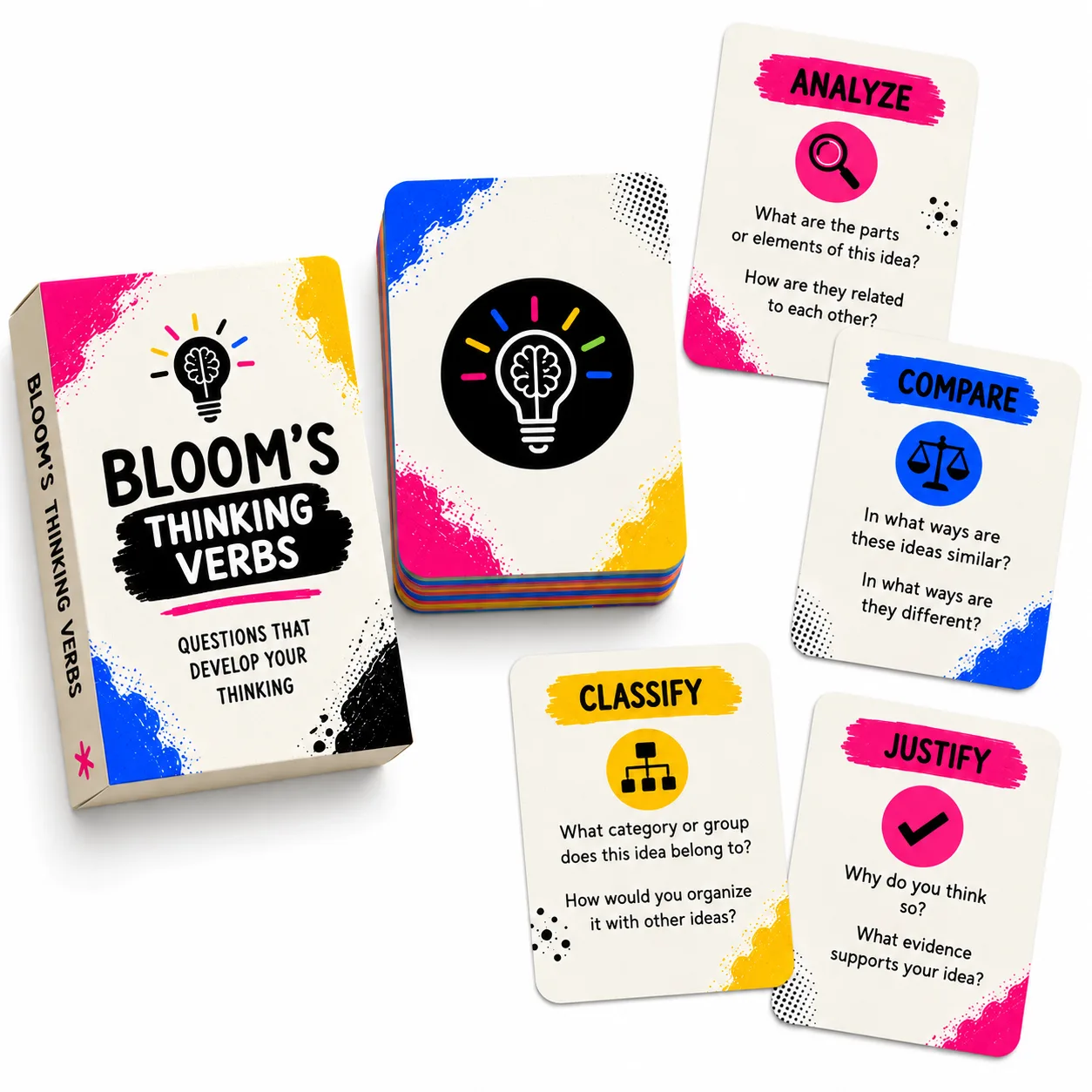
Bloom Cards generate prompts across the taxonomy’s six levels: remember, understand, apply, analyze, evaluate and create. For competency assessment, the higher levels are the most revealing: an “evaluate” level task (“Which of these two solutions is better and why?”) or a “create” level task (“Design an experiment that demonstrates…”) cannot be resolved by memorizing — it requires real understanding and mobilization of knowledge. The cards also serve to verify that assessment tasks are distributed across different levels, not concentrated only at the lower ones.
Summary Cards — as evidence of synthesis
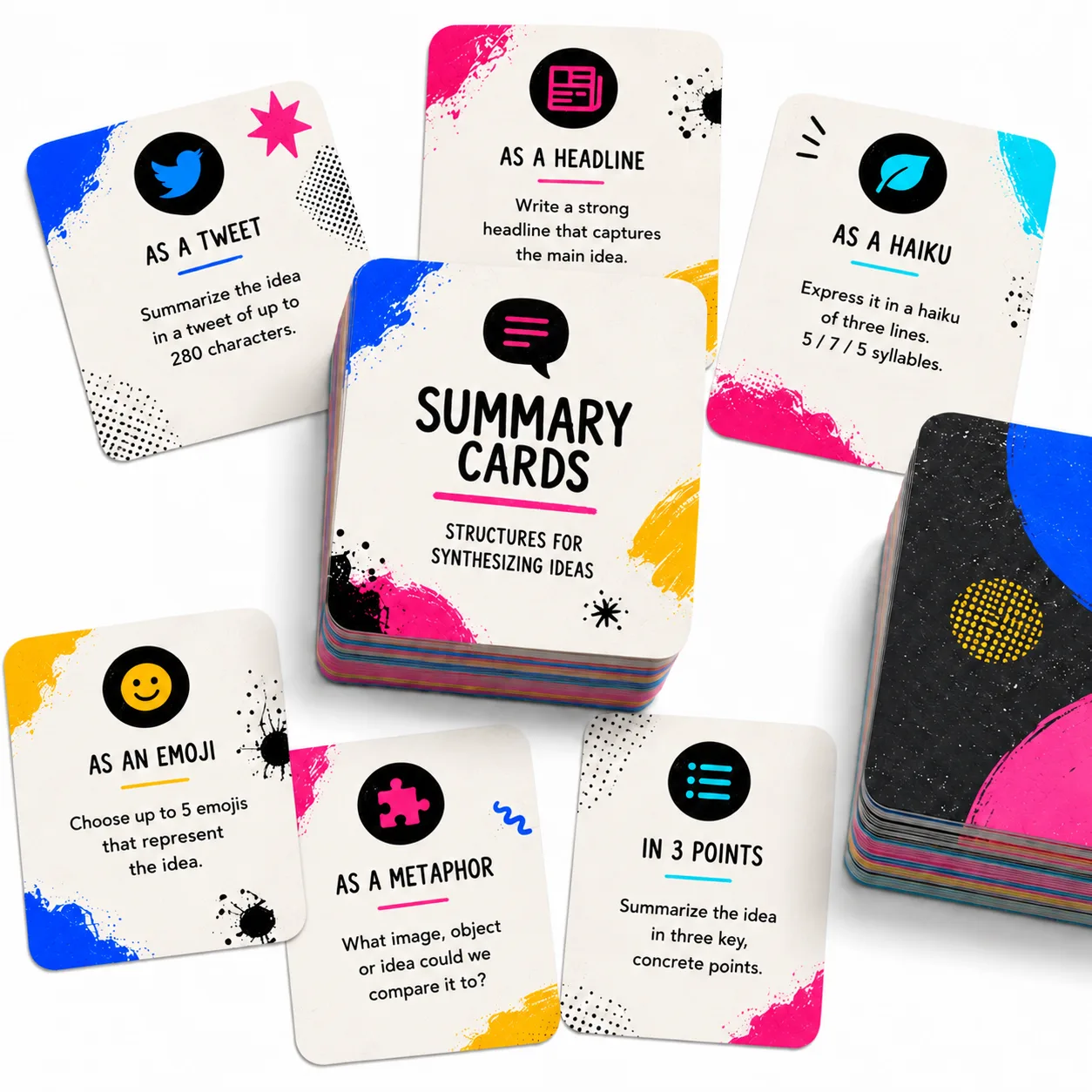
A good synthesis is evidence of competency that few tools can replace: to synthesize well, the student must select what is important, prioritize ideas and reformulate them in their own words. Summary Cards structure this process in a manageable format. Used as a unit closing, they clearly reveal what each student understood and what remained on the surface — without needing a formal exam.
Common mistakes
Calling any practical activity a competency. A practical activity is not automatically competency assessment. Copying a map does not assess geographic understanding; constructing an argument from a map does. The key is whether the task requires mobilizing knowledge to resolve something, not just reproducing information in a different format.
Designing rubrics with format criteria, not comprehension criteria. “Has introduction, development and conclusion” describes structure, not understanding. “The student uses evidence from the text to support their position” describes a competency. The test: if the criterion can be met without understanding the topic, it is a format criterion.
Eliminating content in the name of competencies. Competency does not exist in a vacuum — it exists applied to a domain of knowledge. Teaching argumentation in general, without specific content, produces students who know the structure of an argument but have nothing substantial to argue about. Content and competency develop together, in the context of tasks that require both.
Assessing the competency only once. Competencies develop over time and in different contexts. A single task at the end of the unit is insufficient to assess whether the student developed the competency or simply got lucky in that instance. Continuous formative assessment — small pieces of understanding evidence throughout the process — gives a much more reliable picture of actual learning.
What competencies it develops
Competency-based assessment does not only assess competencies — it also develops them, because the process of facing authentic tasks is itself an exercise in the same capacities that are sought:
- When students work on a task that requires deciding how to approach it, what information to use and how to present their position, they are exercising problem-solving: mobilizing what they know to reach a solution in a real, not simulated, context.
- When they choose between different ways of approaching the task — format, focus, quality criteria — they are practicing decision-making: evaluating options with judgment and committing to a direction.
- When they monitor their own process — what they know, what they are missing, how they are progressing — they are developing metacognition: the ability to think about their own learning.
- When they adjust their work based on feedback received before the final submission, they are practicing self-regulation: the ability to modify the process based on available evidence.
How to start
- For the next assessment task: design the rubric first with the generator, before defining the task. Identify what specific competency is to be evidenced and make sure the rubric criteria describe behaviors of that competency — not format characteristics.
- For an authentic task: redefine an existing task so it has a purpose beyond the grade. Instead of “write an essay on climate change,” propose “write an opinion letter to the school newspaper about a concrete measure your city could take.” The content is the same — the purpose changes everything.
- For process assessment: incorporate I Used to Think, Now I Think at the start and close of the unit, and the exit ticket in the intermediate classes. At the end, the teacher has evidence of how understanding evolved — not just where it landed.