Differentiated Instruction
Adapting content, process, product, and environment according to each student's needs.
What is it?
Differentiated instruction starts from a simple premise: students are different, so teaching should be too. It is not about making a separate plan for each student but designing a class with intentional variations that respond to different profiles, interests, and levels of readiness.
Carol Ann Tomlinson identifies four elements that can be differentiated: content (what they learn), process (how they learn it), product (how they demonstrate what they learned), and learning environment (where and with whom they learn). It is not necessary to differentiate everything at once — you start with whichever element makes most sense.
Differentiation is not lowering expectations or giving less work to some students. It is offering different paths toward the same demanding learning objectives. An advanced student does not need more work but more complex work. A student who needs support does not need less content but different scaffolding.
Differentiated instruction is not a set of strategies. It is a philosophy: believing that all students can learn and that it is our responsibility to find the path.
— Carol Ann TomlinsonWhat does it look like in class?
In math, the teacher presents the same concept to the whole class and then offers three practice levels: basic exercises, intermediate application, and extension problems. Students choose or the teacher assigns based on diagnostic assessment.
For a research project, students can choose the topic within the curricular area. Those interested in sports research statistics; those who like music analyze sound patterns. The curricular content is the same but the vehicle is different.
The teacher uses flexible groupings: sometimes by level for focused instruction, sometimes mixed for peer support, sometimes by interest for projects. Groups change depending on the activity — they are not fixed.
While one group works autonomously with a guide, the teacher sits with a small group that needs additional explanation. Then rotates. Everyone receives personalized attention during the week.
Signs it works
- Advanced students are genuinely challenged, not bored waiting for others to finish
- Students who need more support participate actively instead of getting frustrated and disengaging
- Working groups change regularly — there are no fixed groups of 'fast' and 'slow' students
- The teacher knows each student's level and adjusts intervention accordingly
- Students perceive the variations as normal, not as a stigma
Common mistakes
Creating fixed-level groups that become permanent labels — grouping must be flexible
Differentiating by lowering expectations instead of adjusting the path — everyone must reach demanding objectives
Trying to differentiate everything at once from day one — it is more sustainable to start with one element
Confusing differentiating with individualizing — it is not a plan per student but strategic variations within the class
Key thinkers
Professor at the University of Virginia and creator of the differentiated instruction model. Her book The Differentiated Classroom is the world reference.
Spanish educator and trainer specializing in diversity attention and curricular differentiation in regular classrooms.
Authors of Differentiated Instructional Strategies. Their work offers concrete tools for differentiating in any subject.
Dive deeper
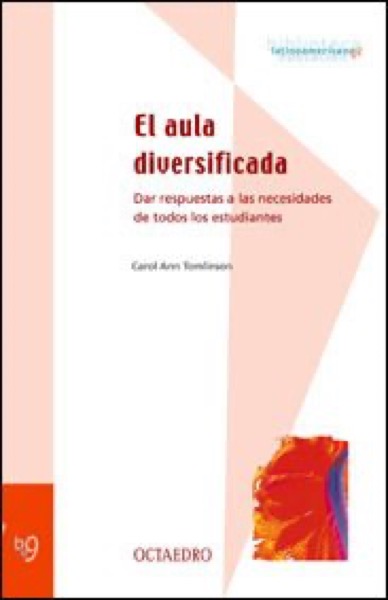 BookThe Differentiated Classroom — Carol Ann Tomlinson
The foundational book of differentiated instruction. Clear, practical, and full of strategies applicable from the next day.
ES PDFInclusive and Personalized Digital Learning
ProFuturo report on how to use digital tools to personalize learning and address classroom diversity. Practical cases of differentiation with technology.
 WebsiteCognitive Load Theory (CLT) — DEXPA
Why working memory has limits and how to design instruction that does not overload it: the cognitive foundation behind differentiation and scaffolding.
ESWebsiteAttention to Diversity — Spain Ministry of EducationResources from Spain's Ministry of Education on diversity attention and inclusive approaches.
WebsiteDifferentiated Instruction — EdutopiaCollection of articles, videos, and differentiation strategies from Edutopia. Many visual resources.
VideoCarol Ann Tomlinson — Differentiation in the ClassroomTomlinson explains the principles of differentiated instruction with concrete classroom examples.
 ToolChoice Board
 ToolComprehension Stoplight
 ToolExit Ticket
 ToolKWL Organizer