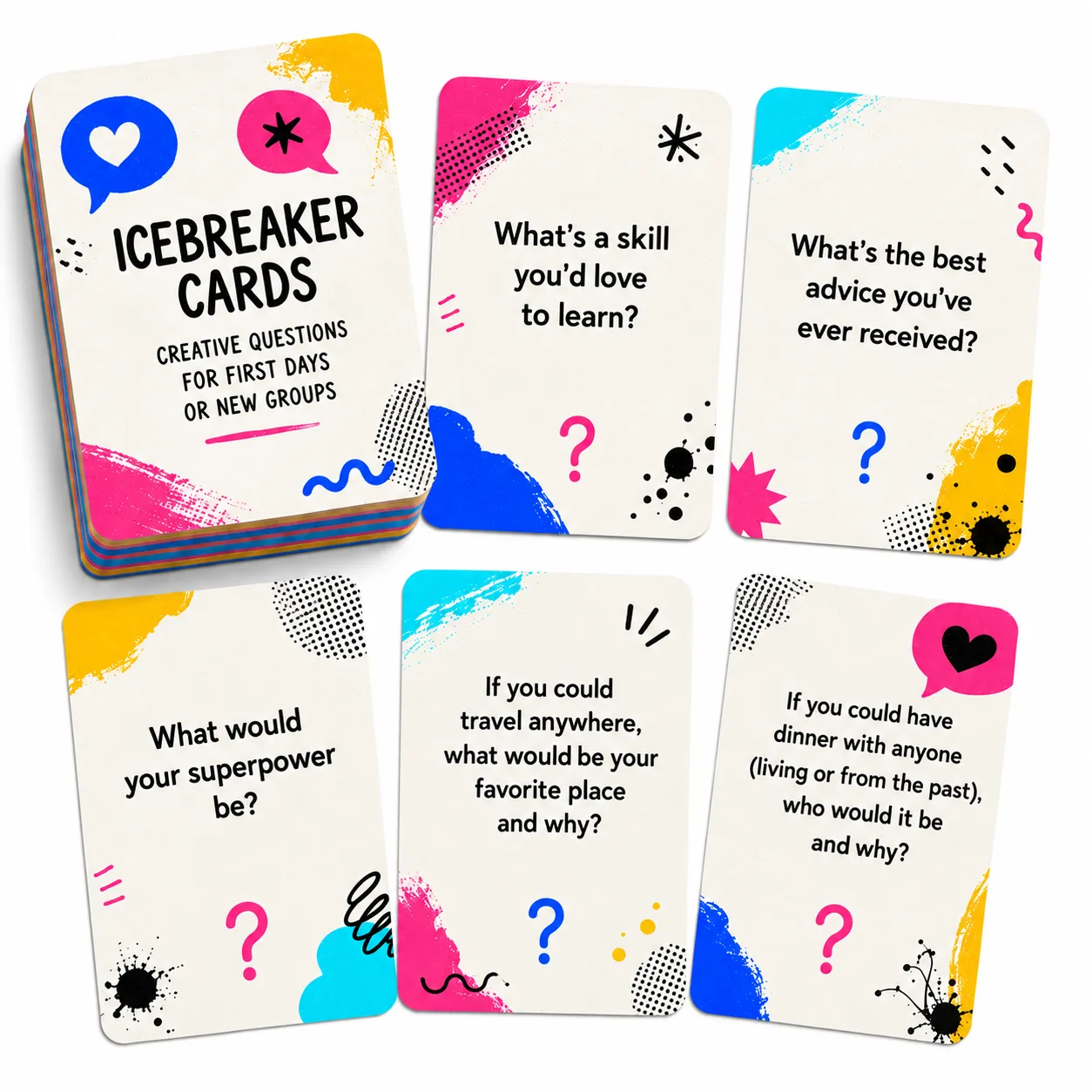
Icebreaker Cards for the Classroom
Icebreaker Cards offer a low-pressure starting point for conversation at the beginning of the year, the beginning of a class, or any moment when the group needs to reconnect. Each card presents an open-ended question designed to be accessible to everyone: there are no right or wrong answers, no sensitive information required, no preparation needed. The goal is simple — creating a brief shared moment that makes the classroom a slightly more human place.
Why classroom climate matters for learning
Research in educational psychology consistently shows that students learn better in environments where they feel safe, seen, and connected to their peers. Classroom climate is not a “soft” variable or a luxury add-on to instruction: it is a foundational condition. Students who feel unknown in their classroom take fewer intellectual risks, participate less, and retain less. Icebreaker activities are one of the simplest tools for building that climate — a small investment of time with disproportionate returns in group cohesion.
The “pass is always valid” rule
The only norm worth establishing from the first use of the deck: no one is ever required to answer. “Pass” is always valid, with no explanation needed. This seemingly small norm has a large effect: knowing you can opt out makes the space safer for everyone, because participation is clearly voluntary rather than compulsory. Paradoxically, protecting the right not to participate tends to increase authentic voluntary participation over time.
A ritual, not just an activity
The most powerful use of the icebreaker deck is not as a one-time activity but as a regular ritual: 5 minutes at the start of class, once or twice a week. That rhythmic repetition does something a single activity cannot — it builds a shared language, establishes that people matter before the content does, and signals that this classroom is a place where being known is valued. Over a year, those accumulated 5 minutes become the foundation of a group that can navigate challenge together.
Frequently asked questions about Icebreaker Cards
What type of questions does the icebreaker deck include?
The deck includes questions designed to be light, accessible, and connection-oriented. They fall into several categories: preference questions (if you could only eat one food for a month, what would it be? Would you rather fly or be invisible?), imagination questions (if you could travel to any time period, where would you go?), experience questions (what's something you've learned recently outside of school?), aspirations questions (what's something you'd like to learn this year?), and reflection questions about the group itself (what's one thing you'd want your classmates to know about you?). None require revealing personal or sensitive information — all are designed to generate conversation without pressure.
When during the school year is the deck most useful?
The deck has a natural use at three moments. At the beginning of the year: the first days of class, when students are getting to know each other and the classroom climate is still fragile. It also works at the start of each class as a brief warm-up: 5 minutes where someone draws a card and 2 or 3 people answer. This creates a continuity ritual that makes the transition from recess or hallway to class easier. And in transition moments: after vacations, at the start of a new unit, or after a difficult session, icebreaker questions help reset the emotional tone of the group.
How do you use the deck in a large group?
In large groups, it doesn't work well for everyone to answer the same card: it takes too long and attention gets lost. More efficient alternatives: the teacher draws a card and chooses 3 or 4 students at random to answer; or draw a card and ask students to turn and share their answer with the person next to them, then share one interesting answer from the pair in the big group; or draw a card and ask for voluntary answers until 5 or 6 have come up. In all cases, the important thing is that the activity stays light and doesn't feel like a formal obligation.
What do you do if students feel uncomfortable answering?
No student should be forced to share in a public icebreaker activity. The most effective norm to establish from the start is 'pass is always valid': whoever doesn't want to answer a particular question can simply say 'pass' and the next person continues. This norm protects the most introverted or shy students and paradoxically makes the space safer for everyone — knowing that opting out is allowed makes voluntary participation more authentic. Over time, as the classroom climate improves, students who were initially reluctant usually begin participating voluntarily.
Does the deck only work at the beginning of the year?
No, though that's the most obvious use. The deck also works as a brief opener at the start of any class: 5 minutes that break the inertia of coming from another class or recess. It works as a transition to reconnect the group after vacations or disruptions. And it works as a low-stakes activity on days when the group needs a break: after exams, at the end of a demanding unit, or on days when the energy in the room is clearly low. The questions are light enough to not require mental effort, but generate genuine conversation.
Can the activity be adapted for virtual classes?
Yes, and it works particularly well in virtual environments where the lack of physical presence makes building connection harder. In a video class, the teacher projects a card and students answer in chat or take turns unmuting to respond verbally. In asynchronous environments, the card question can be posted in a forum or discussion board and students respond at their own time. In virtual classes at the start of the year, dedicating 5 minutes to an icebreaker card makes a significant difference in the group's willingness to participate during the rest of the session.
How is icebreaker different from regular conversation?
The key difference is structure. Regular conversation in a classroom happens naturally between students who already know each other, but rarely extends to the whole group in a deliberate way. Icebreaker provides a frame: a specific question everyone answers, creating a brief moment of shared attention that is different from social conversation. That structured moment does something that spontaneous conversation doesn't: it includes students who would not naturally speak up, and it gives everyone a clear entry point to participation that does not require them to invent a topic from scratch.
What pedagogies and competencies does the icebreaker deck connect with?
The activity is grounded in the principles of Social-Emotional Learning: building classroom climate, emotional safety, and a sense of belonging are foundational conditions for learning. It also applies principles of Restorative Practices: investing in relationships before conflict arises is more effective than managing conflict once it has occurred. At the competency level, it activates Active listening, Empathy, and Assertive communication. It also connects with Pedagogy of Care: the act of making time for students to be known as people, not just as learners, is itself a pedagogical stance.