The problem: questions that look for the right answer
Most questions asked in the classroom are not designed to generate thinking. “Did everyone understand?”, “What is the capital of France?”, “Who discovered America?” — these are questions that seek a single, predetermined answer that the teacher already knows. The student does not need to think to answer them; they need to remember.
This is not a subjective perception. Observational studies in real classrooms show that between 60% and 80% of teacher questions are at a low cognitive level: recall or recognition (Gall, 1970; Wragg & Brown, 2001). The pattern repeats across all educational levels and multiple countries.
The problem is not that these questions exist — they have their legitimate function — but that they dominate the repertoire. When the only questioning tool is the closed question, the classroom becomes a space where information is verified rather than understanding built.
The theory behind the practice
Bloom’s taxonomy (1956), revised by Anderson and Krathwohl (2001), organizes cognitive processes into six levels: remember, understand, apply, analyze, evaluate and create. The questions we ask determine at which level the student operates. A recall question activates memory; an analysis question activates relational thinking; an evaluation question demands reasoned judgment.
Walsh and Sattes (2005, 2011) spent two decades studying the quality of questions in the classroom. Their central finding: higher-order questions produce longer, more elaborated responses with greater evidence of deep understanding. But they represent only 20% of a typical teacher’s questions.
Ritchhart, Church and Morrison (2011), from Harvard’s Project Zero, proposed a complementary approach: rather than improving teacher questions as an isolated action, design thinking routines — brief, repeatable structures that make student thinking visible. Routines like I Used to Think, Now I Think or See-Think-Wonder generate questions naturally, without the teacher having to formulate them all.
The practical conclusion is clear: the goal is not to ask more questions, but to ask questions that activate higher-complexity cognitive processes, and to create spaces where students formulate their own.
Four types of questions and what they activate
| Type of question | Cognitive level | Example | What it activates |
|---|---|---|---|
| Closed | Remember | “In what year did the French Revolution begin?” | Memory. The student retrieves a piece of data. |
| Open | Analyze / Apply | “What conditions made the French Revolution possible?” | Relational thinking. The student connects causes, contexts, variables. |
| Philosophical | Evaluate | “Can violence be a legitimate means to achieve social change?” | Reasoned judgment. There is no correct answer; there are better and worse arguments. |
| Metacognitive | Reflect | “What was the hardest thing to understand today and why?” | Thinking about one’s own thinking. The student monitors their process. |
All four types are useful. The goal is not to eliminate closed questions but to increase the proportion of the other three. A good questioning repertoire combines all four in the same class.
How to turn a closed question into one that makes students think
The most accessible technique is to take a recall question and reformulate it to require analysis, evaluation or reflection. It does not require preparing new material — just changing the phrasing.
Example 1: Geography
- Closed: “What is the capital of France?”
- Reformulated: “Why do capitals tend to be the largest cities in a country? Is this always the case? Can you think of a counterexample?”
Example 2: Biology
- Closed: “What is photosynthesis?”
- Reformulated: “If plants could not perform photosynthesis, what would change first in an ecosystem and why?”
Example 3: Literature
- Closed: “Who is the protagonist of the novel?”
- Reformulated: “Does the protagonist change throughout the story? At what moment do they stop being the same character they were at the beginning?”
Example 4: Mathematics
- Closed: “What is 3/4 + 1/2?”
- Reformulated: “Why can fractions not be added directly like whole numbers? What is lost if you just add the numerators without more?”
In each case, the reformulated question does not have a single answer. It requires the student to think, compare and justify. And it opens the door to new questions arising from the answers — something a closed question never allows.
Free tools for each type of question
Asking good questions is a skill developed through practice. The following tools work as scaffolds: they help the teacher formulate higher-quality questions and students to develop more in-depth responses.
Bloom Cards — for scaling complexity
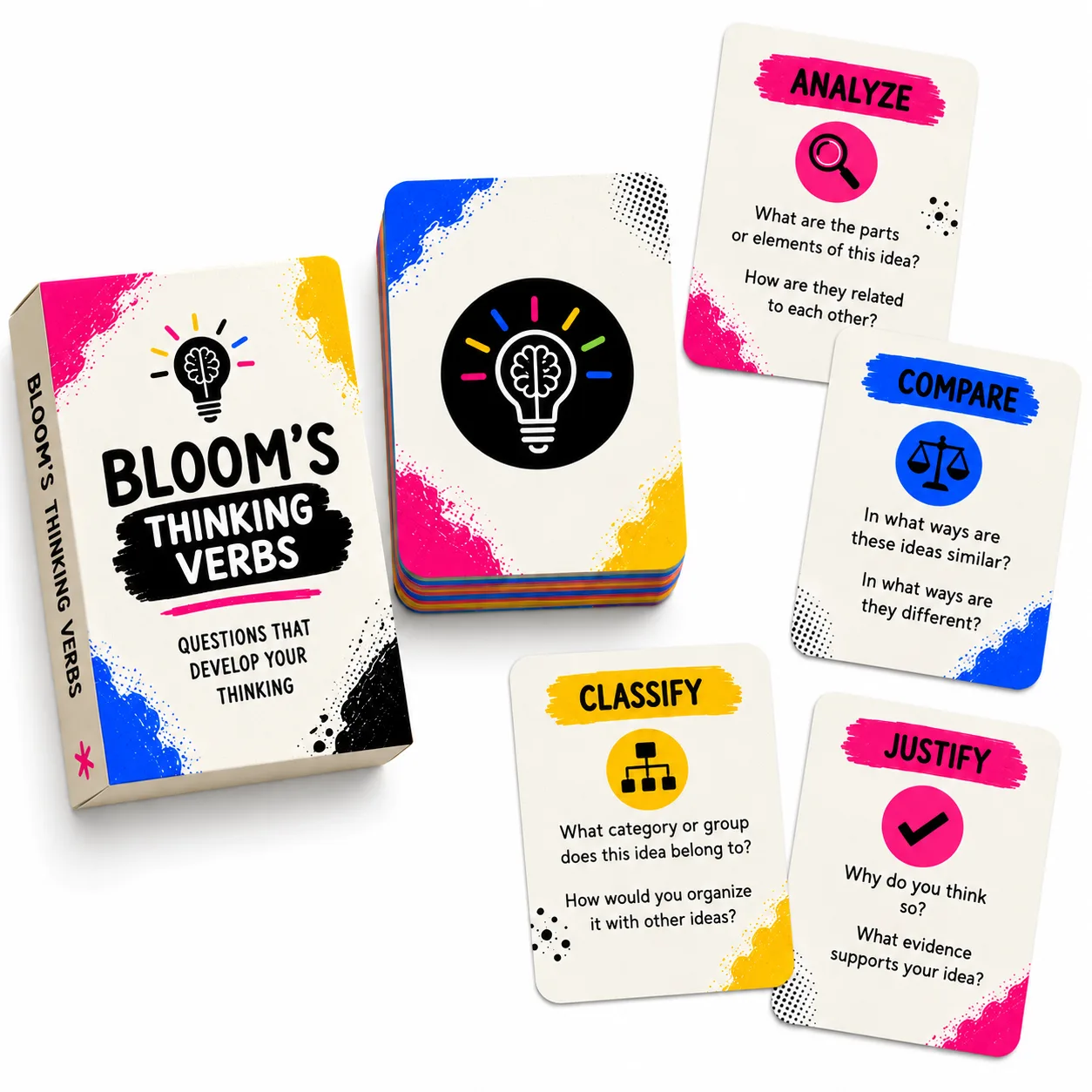
When a teacher wants to move beyond the recall level but is not sure how to reformulate the question, Bloom Cards offer an immediate structure. A cognitive level is selected (analyze, evaluate, create) and the card provides verbs and guidelines for that level. It is useful in lesson planning, but also in real time: if discussion gets stuck on facts, a card from a higher level can relaunch it.
Connector Cards — for responses that go beyond one sentence
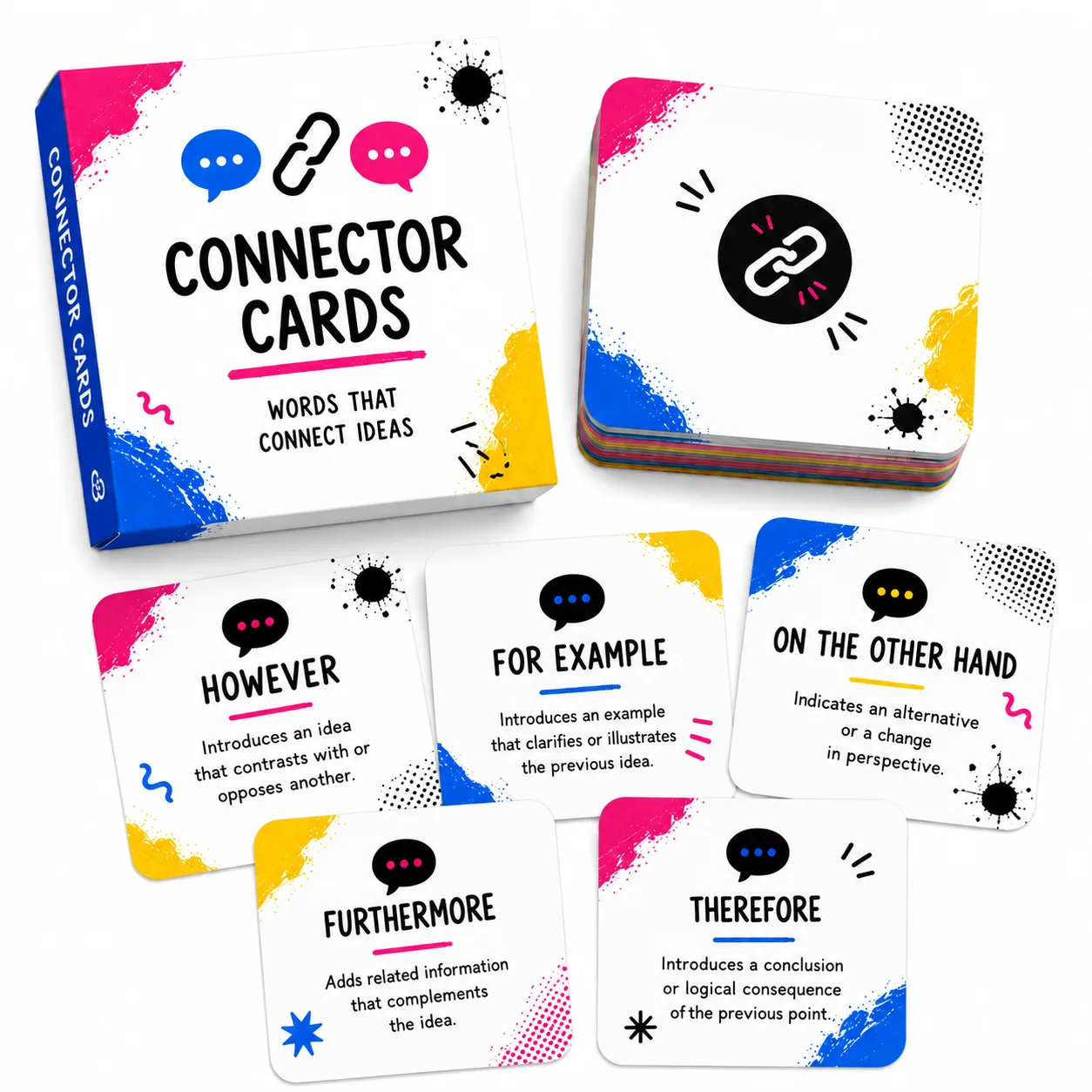
The problem is not always in the question but in the response. Many students answer with short sentences even in the face of open questions. Logical connectors (“however,” “this is due to,” “unlike”) work as structure for thinking. When assigned a connector at random, the student is forced to extend their reasoning and establish relationships that they would otherwise not make explicit.
KWL Chart — for students to formulate their own questions
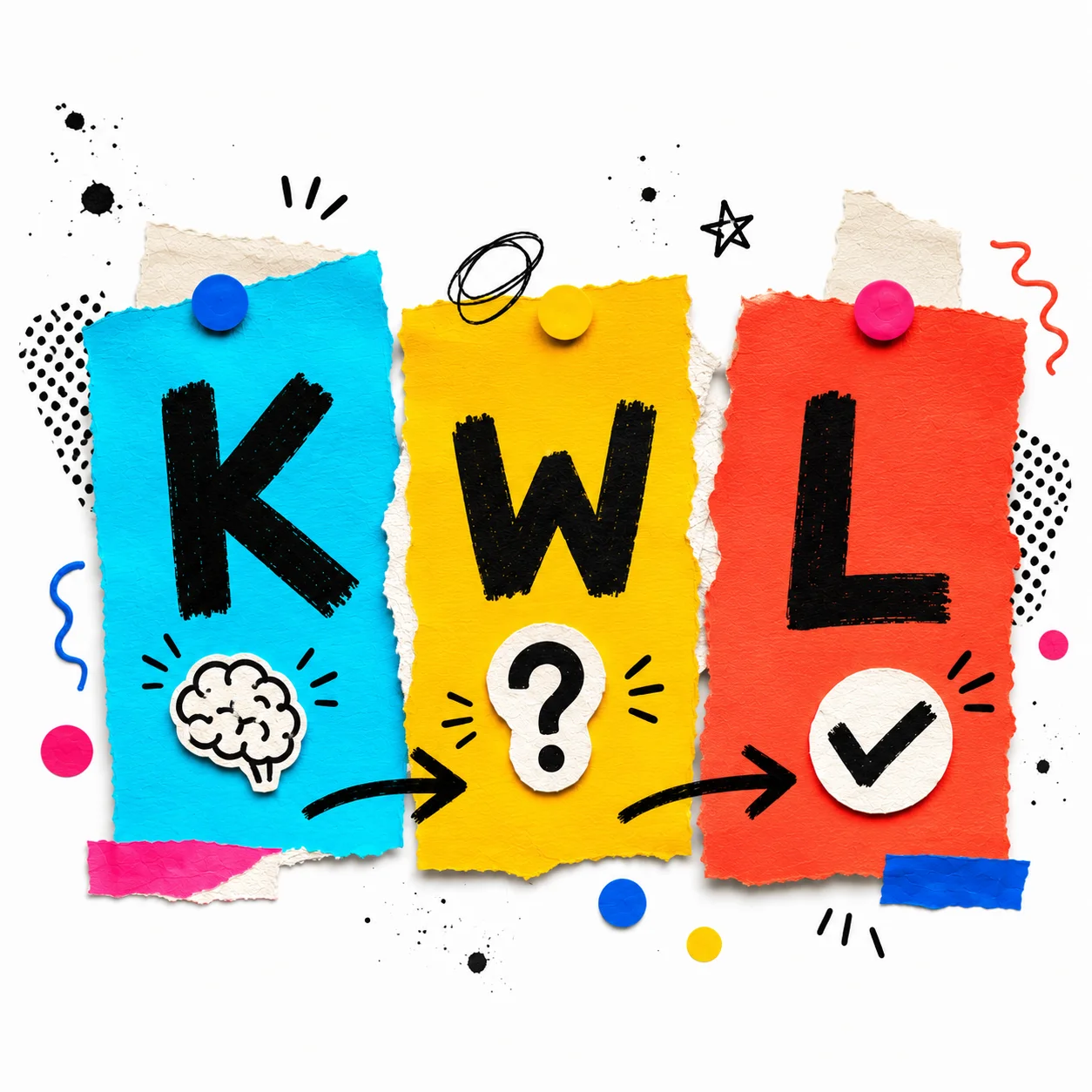
The middle column of the KWL (what I want to know) transfers question formulation to the student. When a student writes “I want to know why dinosaurs went extinct but crocodiles did not,” they are generating a genuine analytical question — not because the teacher assigned it, but because their curiosity produced it. The KWL is especially effective at the start of a unit, when there is still room for the group’s questions to guide the exploration.
I Used to Think, Now I Think — for metacognitive questions
This visible thinking routine generates metacognitive questions naturally. When a student writes “I used to think metals were the best conductors” and then “now I think it depends on the context and temperature,” the comparison between both columns leads them to ask: what changed in how I understand this? What new information triggered the change? This is the metacognitive question that is hardest to ask directly, but one that emerges on its own when there is a visible contrast.
Venn Diagram — for comparative analysis questions
Comparing two concepts forces analytical questions: how are animal and plant cells similar? How are they different? Why do they share certain structures but not others? The Venn diagram externalizes that comparison process. It is useful when the teacher wants students to practice analysis without needing to frame it as a complex prompt.
Debate Cards — for evaluative questions
Evaluative questions (“Is it fair that…?”, “What is the best solution for…?”) require the student to take a position and defend it. Debate Cards assign roles and positions at random, eliminating the tendency to always choose the comfortable position. The student must formulate questions for the other team, anticipate counter-arguments and justify their position — the highest level of elaboration a question can produce.
Common mistakes
Answering your own question. It is the most common mistake. The teacher formulates a good open question and, receiving no immediate response, reformulates it as closed or simply gives the answer. Rowe’s (1986) research on wait time shows that most teachers wait less than 1.5 seconds before intervening. Increasing that time to 3 to 5 seconds significantly increases both the quality and the length of responses.
Only asking those who raise their hand. This creates a closed circuit: the same 4 or 5 students participate, the rest disconnect. Techniques such as random name selection or collective response tools (where everyone answers simultaneously) ensure that the question is an event for the whole class, not just a few.
Confusing “open” with “vague.” “What do you think about pollution?” is an open question, but so broad that it does not orient thinking. A good open question has focus and constraint: “Which of these three measures would most reduce pollution in the local river and why?” The openness is in the response, not in the ambiguity of the prompt.
Using questions only to evaluate. If every time the teacher asks a question it is to verify whether the student studied, questions become associated with control, not curiosity. Students stop taking risks in answering for fear of being wrong. The most productive questions are those with no correct answer or those that value the reasoning over the accuracy of the data.
What competencies it develops
Asking good questions — and creating spaces where students formulate their own — directly activates transversal competencies:
- When a student compares two possible explanations and chooses which seems more convincing, they are exercising critical thinking: the ability to evaluate evidence and form reasoned judgments.
- When they build a response using connectors like “therefore,” “however” or “this implies that,” they are practicing logical reasoning: the ability to chain ideas coherently.
- When they formulate their own questions based on what they do not understand or find intriguing, they are developing intellectual curiosity: the engine that sustains learning beyond the classroom.
- When they reflect on how their thinking changed after an activity, they are activating metacognition: the ability to monitor and regulate their own learning process.
How to start
There is no need to transform all questions at once. One small, sustained change has more impact than a complete overhaul that lasts a week:
Choose one closed question per class and reformulate it as open. Use Bloom Cards as support if the reformulation does not come naturally. Increase wait time to 3 seconds before intervening.
Incorporate the KWL Chart at the start of a new unit and let students' questions guide at least part of the exploration. Use Connector Cards so responses gain structure.
Close one class per week with I Used to Think, Now I Think and use the responses to open the next class. Introduce Debate Cards once the group is comfortable with questions that have no single right answer.
The quality of questions improves with practice — both the teacher’s and the students’. What matters is not the perfection of each question, but the decision to make the classroom a space where thinking is more frequent than remembering.