Why many students do not know what to do when nobody tells them what to do
The scene is familiar: the teacher finishes explaining the instructions, says “now work” and a good part of the group stays still, waiting for more specific instructions. It is not that they did not understand the task — it is that they do not have the habit of deciding how to approach it. They have been trained, for years, to follow step-by-step instructions. The school that gives all the instructions produces students who do not know how to function without them.
Autonomy is not a personality trait — it is a skill that is built. And like every skill, it is built with deliberate practice under supportive conditions. A student who has never had to make decisions about their own learning will not become autonomous because the teacher asks them to. They will need a gradual process of responsibility transfer.
The theory behind the practice
Lev Vygotsky introduced the concept of the Zone of Proximal Development (ZPD): the distance between what a learner can do alone and what they can do with support. Optimal learning occurs in that zone — where the task is challenging but achievable with adequate help.
Wood, Bruner and Ross (1976) developed the concept of scaffolding to describe the type of support that allows the learner to operate in the ZPD: temporary structures that are progressively withdrawn as the learner can sustain themselves alone. The metaphor is precise — scaffolding is not part of the building; it is support that is dismantled when it is no longer needed.
Pearson and Gallagher (1983) formalized this process in the gradual release of responsibility model: the teacher starts by doing the full work in front of students (I do), then does it together with them (we do), then students do it with the teacher available (they do with support), and finally students do it alone (they do alone). This model applies to any competency, including autonomy itself.
Edward Deci and Richard Ryan, from Self-Determination Theory, identify autonomy as one of the three basic psychological needs whose satisfaction produces intrinsic motivation. When students have real control over aspects of their learning, their commitment increases — not as a side effect, but as a direct consequence of a basic need being met.
The levels of autonomy: not all or nothing
The most frequent mistake when trying to develop autonomy is framing it as a binary jump: either the teacher controls everything or students decide everything. Neither option works — the first produces dependence, the second produces anxiety and paralysis.
Autonomy is built gradually, in specific dimensions:
| Dimension | Low autonomy | Medium autonomy | High autonomy |
|---|---|---|---|
| What to do | Teacher assigns the task | Student chooses between options | Student proposes the task |
| How to do it | Teacher gives the steps | Student chooses the approach | Student designs the process |
| At what pace | Everyone at the same time | Flexible blocks with dates | Student manages their time |
| How to evaluate | Teacher evaluates | Guided self-assessment | Student proposes their own criteria |
| What comes next | Teacher decides | Student chooses from a list | Student plans their own path |
The teacher can increase autonomy in one or more dimensions, without needing to hand all of them over at once. A good starting point is the choice of how to do something, while maintaining control over what must be achieved.
How to develop autonomy progressively
The first level of autonomy is not that students choose what to learn — it is that they choose how to demonstrate what they learned. Instead of "write an essay on the topic," offer: "you can write an essay, record an explanatory video or design an infographic." The choice board formalizes these options visually.
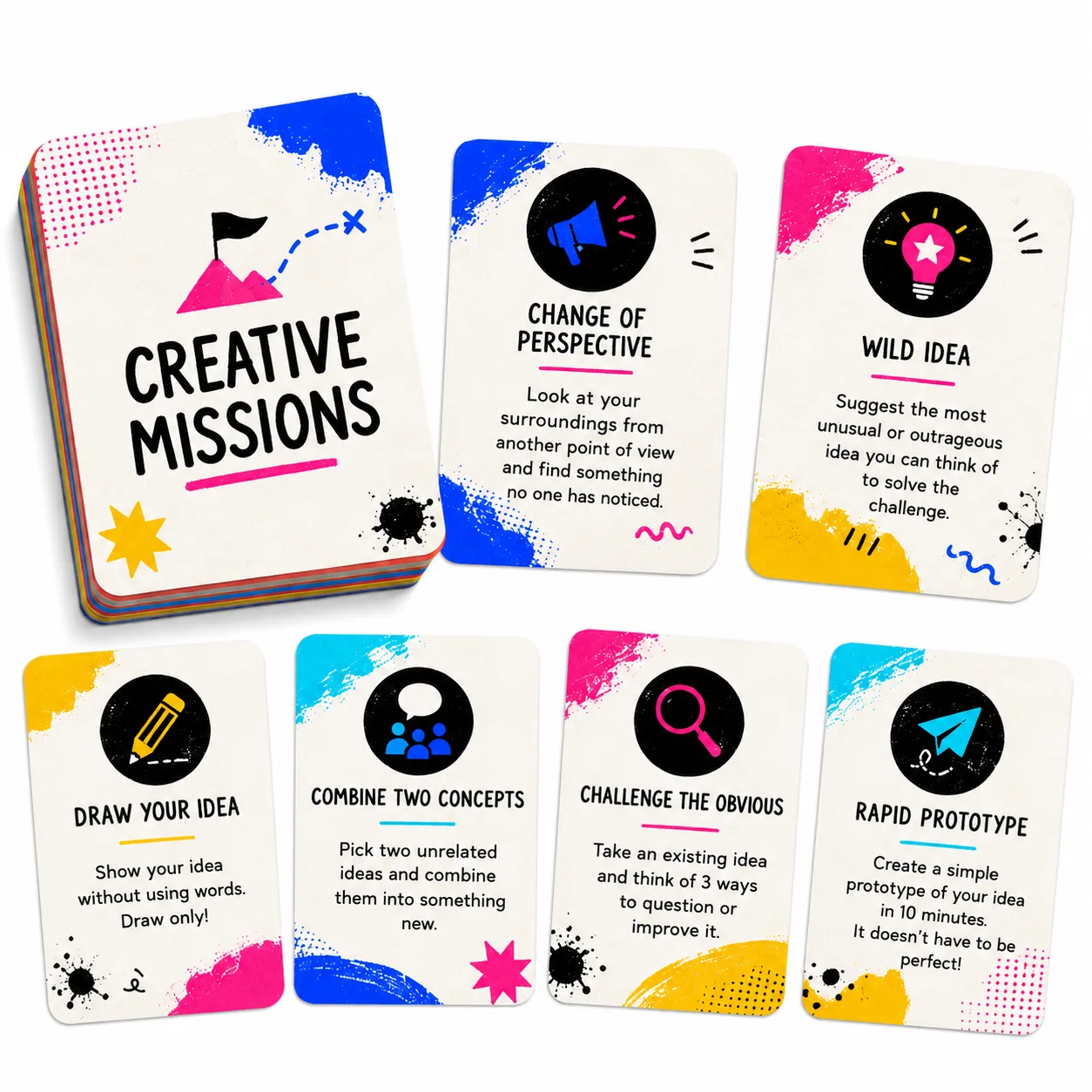
An open instruction is not a vague one — it is one that defines the expected result but leaves the paths to get there open. "Design a way to explain to a 10-year-old why the seasons occur" — the criterion is clear, the path is the student's decision. Creative mission cards propose this type of instruction in card format.
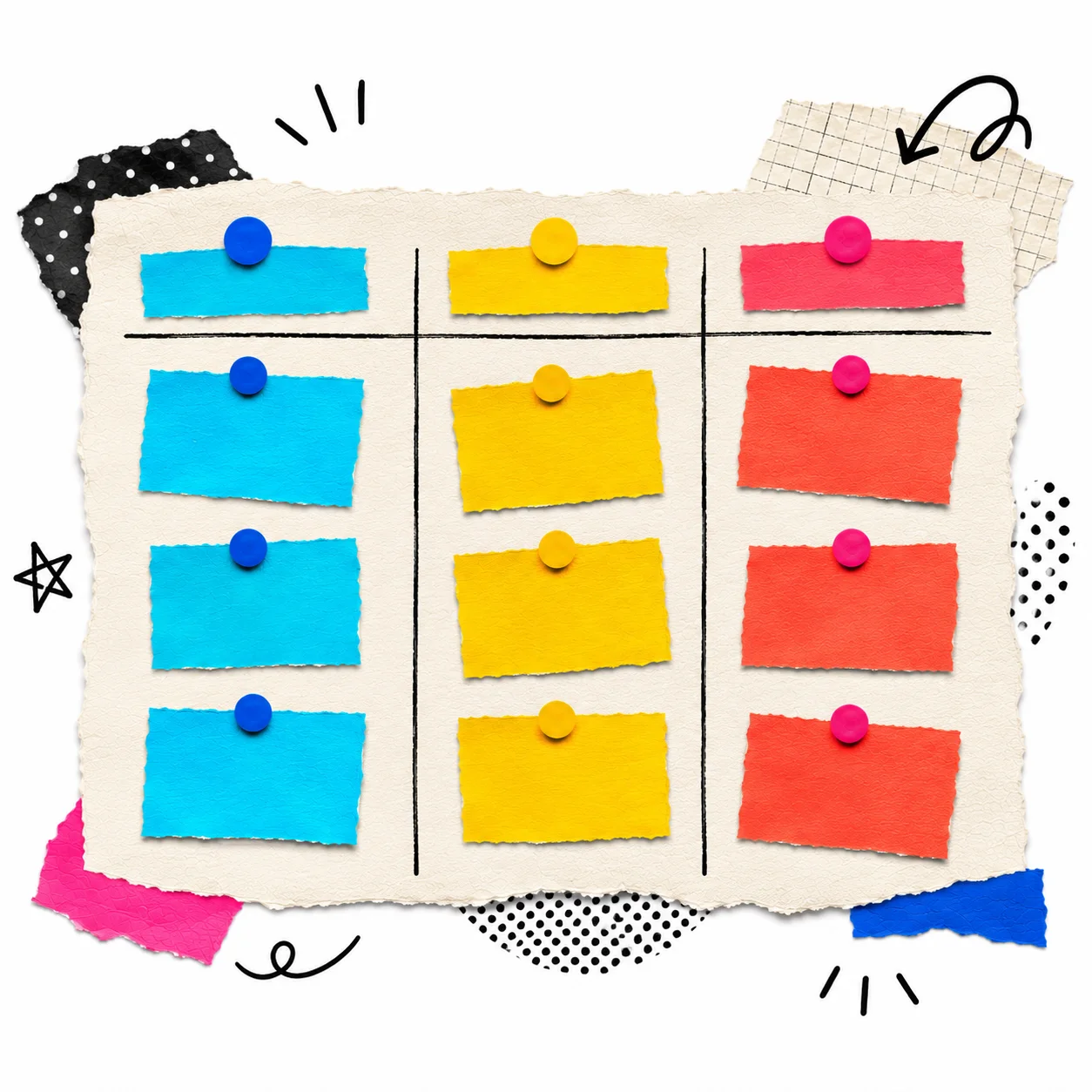
For students to manage their time and tasks, they need to see what they have pending, what they are doing and what they have finished. The kanban board makes this planning visible and allows the teacher to monitor progress without constantly interrupting — and the student to see by themselves where they are and what comes next.
Autonomy requires that students be able to evaluate their own process: what worked, what did not, what they would change. The exit ticket formulated as "What did I decide today? Why? What would I do differently?" trains this reflection routinely.
The most frequent mistake is maintaining the same level of support indefinitely, or withdrawing it too abruptly. Gradual release means the teacher observes when the student can already function without a certain support and withdraws it at that moment — not before, not much after.
What to do with students who do not use the autonomy
When more freedom is given to a group that is not accustomed to it, some students freeze, others always choose the easiest options and others use the time for anything but the task. This is not evidence that autonomy does not work — it is evidence that autonomy has not yet been built.
Some concrete strategies:
Temporarily reduce the openness of the options. Instead of five ways to do the task, offer two. As the student gains confidence in deciding, expand the options.
Include among the options some that are more challenging with additional support resources. And speak explicitly about why choosing the harder path can be more productive — without forcing, but naming the option.
Verify if the instructions have enough clear purpose. Students who know exactly what they are doing something for are more likely to commit. Work with a real audience — like a work gallery — creates that purpose effectively.
Free tools for developing autonomy
Choice board — for starting with autonomy in a structured way
The choice board presents options for activities or product formats. Students choose which one they want to do. This simple choice — within a framework defined by the teacher — is the first step in developing autonomy: the student practices deciding under low-pressure conditions. As the group gains experience with choosing, the options can be opened up more.
Kanban board — for managing one’s own progress
The kanban board organizes tasks in three columns: pending, in progress, done. When students manage their own kanban, they make decisions about what to do first, how to distribute effort and when something is truly finished. These decisions are, in miniature, the same ones that define autonomy in any real work context.
Exit ticket — for training reflection on one’s own process
The formulation of the ticket makes the difference. “What did I decide to do today? Was it a good decision? What would I do differently next time?” turns the close into a self-regulation exercise: the student evaluates their own decisions, not just the result. Over time, this reflection becomes internalized and the student starts doing it without needing the ticket.
Work gallery — for creating accountability with a real audience
When students know their work will have an audience — their classmates, other teachers, the school — they take greater responsibility for quality. This responsibility does not come from fear of the grade but from purpose: the work matters because someone else will see it. The work gallery creates that audience in an organized way and turns the completion of the task into a communicative act.
Creative mission cards — for open instructions with purpose
Each card proposes a mission with multiple valid resolution paths. The openness of the task requires the student to make decisions about how to approach it — what information they need, how they will organize it, what format to use. This is fundamentally different from following step-by-step instructions: the student must plan, not just execute.
Priority voting — for making collective decisions with real consequences
The group votes on which task to address first or which criterion to prioritize. This process is not decorative — it is practice in decision-making with real consequences for the group’s work. Priority voting converts a decision that the teacher habitually makes into one the group makes, with all the discussion and negotiation that implies.
Progress board — for making one’s own progress visible
Each student visualizes where they are in their own process. When progress is visible, students can manage it without the teacher having to tell them what step they are at — which is exactly the goal of autonomy. The progress board also allows the student to compare their current state with the previous one, making progress visible without needing the teacher’s external validation.
Common mistakes
Giving freedom without structure. Autonomy is not the absence of structure — it is internalized structure. A student who does not have clarity about what they must achieve, what the quality criteria are and how much time they have cannot manage their own process. Autonomy requires clear frameworks within which the student has real decision-making.
Rescuing too quickly. When a student faces difficulty, the teacher’s impulse is to intervene immediately. This impulse, well-intentioned, can prevent the student from developing the frustration tolerance and problem-solving capacity that autonomy requires. Observing, waiting and asking “what have you tried so far?” before giving the answer is more pedagogically effective.
Implementing autonomy only in ‘special’ activities. If autonomy appears only in large, occasional projects, it does not become a habit. Autonomy is built in everyday decisions: what order to follow for the exercises, how to organize the notebook, what to do when they finish before the time. These small decisions are the training for the big ones.
What competencies it develops
- When students decide how to approach a task, monitor their progress and adjust their process based on results, they are exercising self-regulation: the capacity to manage their own behavior toward an objective without depending on external supervision.
- When they define what they want to achieve, how they will do it and in what order, they are building goal planning: the capacity to convert an intention into an executable plan.
- When they choose between options with criteria — not just the easiest or most familiar — they are practicing decision making under real conditions.
- When they observe their own process and ask themselves what worked and what they would change, they are developing metacognition: the capacity to think about their own learning.
- When they propose a way to approach something without waiting for instructions, they are exercising initiative and proactivity: the disposition to act before being summoned.
How to start
In the next task, offer two delivery format options instead of one. No need for the student to choose the topic — choosing how to present is enough. Observe how the group chooses and what happens with quality and commitment.
Incorporate the kanban board so students manage their own tasks throughout the process. At the start, the teacher defines the columns and tasks; as the unit progresses, students can add their own tasks.
End each class with the same exit ticket question: "What did you decide to do today and how did it go?" Over time, students start planning the class thinking about the answer they will give — which means they have internalized the practice of making conscious decisions about their own work.