Co-Teaching
Two teachers plan and teach together, combining expertise to better address diversity.
What is it?
Co-teaching (or co-instruction) is a model where two educational professionals share the responsibility of planning, teaching, and assessing in the same classroom. It is not one teacher teaching while the other observes or assists: both are protagonists with defined and complementary roles.
Marilyn Friend identified six co-teaching models: parallel teaching (each teacher teaches the same content to half the group), stations (students rotate between activities led by each teacher), alternative (one works with a small group while the other works with the rest), team teaching (both teach together to the whole group), one teaches/one assists, and one teaches/one observes.
Co-teaching emerges especially in inclusive education contexts, where a classroom teacher and a support or special education teacher work together. But the model is valid between any pair: two subject teachers, a teacher and a specialist, a lead teacher and a student teacher.
Co-teaching is not a luxury. It is the most effective way to address diversity without taking anyone out of the classroom.
— Marilyn FriendWhat does it look like in class?
Stations model: the language teacher works on reading comprehension at one station, the support teacher works on vocabulary at another, and a third station is for independent practice. Students rotate every 20 minutes.
Team model: both teachers teach a science class together. One models the experiment while the other asks inquiry questions. They complement each other naturally, like a planned dialogue.
Alternative model: while one teacher advances with the day's topic with the large group, the other works with 6 students who need reinforcement from the previous topic. The following week the groups may be different.
Joint planning is sacred: 30 weekly minutes where both teachers define what they will teach, who does what, how they assess, and what adjustments they need. Without joint planning, co-teaching becomes co-presence.
Signs it works
- Both teachers move around the classroom and attend to all students, not just 'their own'
- Students address either teacher naturally
- Both teachers plan together regularly — they do not divide tasks separately
- Different co-teaching models are used depending on the activity, not always the same one
- Students who receive special support do so inside the classroom, integrated with their peers
Common mistakes
One teacher teaches and the other is an assistant — without parity, there is no real co-teaching
Not planning together: improvising co-teaching generates confusion and duplication
Always using the same model — variety of models is a strength of the approach
Having the support teacher only work with students who have difficulties — all students benefit from both teachers
Key thinkers
Professor at the University of North Carolina and leading reference for co-teaching. Created the six models used worldwide.
Co-teaching researcher and trainer. Her book Collaborative Teaching in Elementary Schools is a practical reference for implementing the model.
Chilean educator who has worked on co-teaching in the Latin American context. His co-teaching guide is widely cited in the region.
Dive deeper
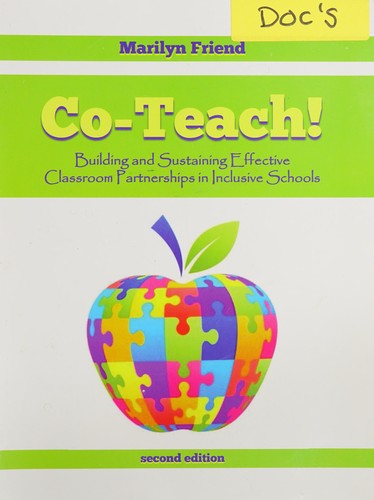 BookCo-Teach! — Marilyn Friend
The co-teaching reference book. The six models explained with examples, planning tools, and implementation strategies.
ESPDFCo-Teaching — Felipe RodriguezPractical guide in Spanish on co-teaching. Defines the model, roles, and offers tools for joint planning.
WebsiteCo-Teaching Connection — Marilyn FriendMarilyn Friend's official site with resources, videos, and materials on co-teaching models.
ESVideoCo-Teaching in the Classroom — EducreaVideo in Spanish explaining co-teaching models and showing implementation examples in Latin American schools.
 ToolKanban Board
 ToolComprehension Stoplight
 ToolVisual Timer
 ToolExit Ticket