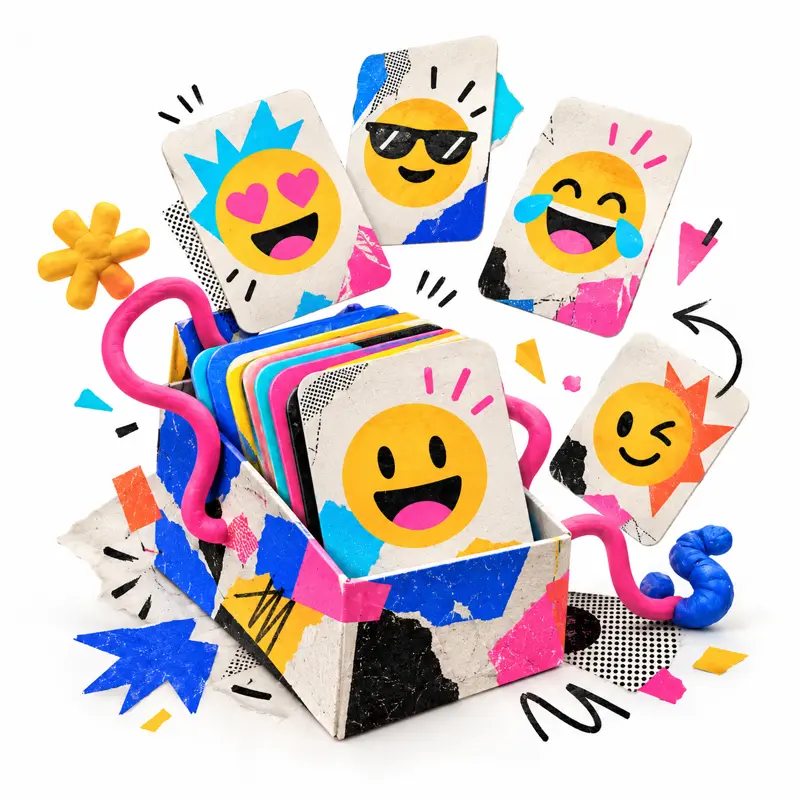
Emoji Cards for the Classroom
Emoji Cards turn any content into a participatory activity in seconds: each student draws a random emoji and must find a connection with the class topic. The apparent simplicity of the activity conceals a genuine cognitive exercise — connecting a visual symbol with an abstract concept requires synthesis, analogy, and understanding. There is no wrong answer as long as the connection can be explained, which lowers the participation barrier for the whole class.
Why the emoji activates conceptual understanding
Answering a direct question about the topic (“what is photosynthesis?”) activates memory. Connecting an emoji with the topic (“how does this sun represent the process of photosynthesis?”) activates understanding. The difference is that in the second case the student needs to identify a relevant characteristic of the concept, not just retrieve a definition. That analogy and synthesis operation works understanding more deeply than repetition, and the visual nature of the emoji makes the process more accessible and less intimidating.
One use for every moment in the lesson
The deck works at three strategic moments: as an opener, to activate what students remember from the previous topic; as a mid-class check, to see what they understood from what they just heard; and as a closer, for each student to synthesize what they learned in the session. Each use has a different logic, but all share the same simple mechanic that requires no additional preparation.
The unexpected connection is the most valuable one
The best answers with emoji cards are not the most obvious ones but the most unexpected: the student who connects the octopus emoji with the structure of power in the Roman Empire, or who uses the seed emoji to explain the concept of potential in Physics. Those connections reveal a deep, metaphorical understanding that does not appear in a conventional answer. Celebrating those connections out loud changes the participation culture of the group.
Frequently asked questions about Emoji Cards
How exactly does the emoji card activity work?
The teacher projects the deck on the classroom screen and a student draws a card at random. The card shows an emoji — it could be a face, an object, an animal, or a symbol — and the student must find a connection between that emoji and the topic they are working on. There is no wrong answer as long as the connection can be explained: if the fire emoji comes up and the topic is the Industrial Revolution, a valid answer might be 'it represents the steam engines', another 'the heat of the first furnaces', another 'the destruction of previous ways of life'. The multiplicity of possible connections is part of the activity's value.
What is the purpose of connecting emojis with academic content?
The exercise of connecting a visual symbol with a concept activates a different type of thinking than answering direct questions: instead of retrieving information, the student needs to make an analogy, identify a relevant characteristic of the concept, and express it in a compressed form. That synthesis and association process works conceptual understanding more deeply than repetition. Also, the visual and unexpected nature of the emoji removes the pressure of giving the correct answer, which lowers the participation barrier for students who normally don't contribute.
When in the lesson is the emoji deck best used?
It works very well at three different moments. As an opener: draw three cards at the start of class and ask each student to choose the one that best represents what they remember from the previous topic, then share their reason. It activates prior knowledge before moving forward. As a closer: each student draws a card and uses the emoji to synthesize what they learned in the session. As a mid-class comprehension check: after explaining a concept, the teacher draws a card and asks students to connect the emoji with what they just heard. The responses reveal what they understood and what they didn't.
Does it work better individually or in groups?
It works well in both formats, but with different dynamics. Individually, each person draws their card and the connection is more personal and intimate: it reflects how each person understands the topic. The share-out reveals the diversity of perspectives. In groups, the group receives a card and must agree on one connection: that generates a small discussion about which aspect of the topic is most central or representative, which works argumentation implicitly. For large groups, the group format is more manageable.
Is it appropriate for all subjects?
Yes, and it tends to be especially productive in subjects where concepts are abstract or hard to visualize. In Mathematics: connecting an emoji with a concept like fractions or symmetry forces visual or metaphorical thinking. In Science: connecting emojis with processes like digestion or the water cycle. In History: which emoji best represents the French Revolution or World War II. In Literature: which emoji best describes the protagonist of the work being read. The apparent frivolity of the emoji lowers the student's guard and opens a space for freer thinking.
What if a student gets an emoji they can't connect to the topic?
That is part of the activity and is fine. The teacher can invite the group to help: does anyone see a connection between this emoji and the topic? A student not finding an immediate connection is also valuable information about their level of topic understanding — or it simply shows that some connections are harder than others. A useful rule: if after 30 seconds the student finds nothing, they can draw a second card. But encourage trying, because the most unexpected connections are often the most interesting.
How many students can participate per session?
There is no technical limit. In small groups (up to 15 people), everyone can draw a card and share their connection in about 15 minutes. In larger groups, the teacher can randomly select 5 or 6 students to share, or do the activity in small parallel groups and then share one connection per group. It also works well as an exit activity: each student draws a card at the end of class and writes their connection on a small piece of paper they hand in as they leave, giving the teacher a quick overview of the group's overall understanding.
What competencies does this activity develop?
Emoji Cards primarily develop Creative thinking (finding non-obvious connections between a symbol and a concept), Assertive communication (explaining a connection clearly and with justification), and Metacognition (students need to reflect on which aspects of the topic they master to make the connection). In group variants it also develops Active listening and Collaboration.
What pedagogies support using emojis as a learning tool?
The activity falls within Visible Thinking: emojis act as triggers that make the student's thinking about the content visible. It also applies principles of Question-Based Learning (the card generates an implicit question: what does this symbol have in common with the topic?) and Experiential Learning (understanding is built through the experience of making connections, not through listening to explanations).