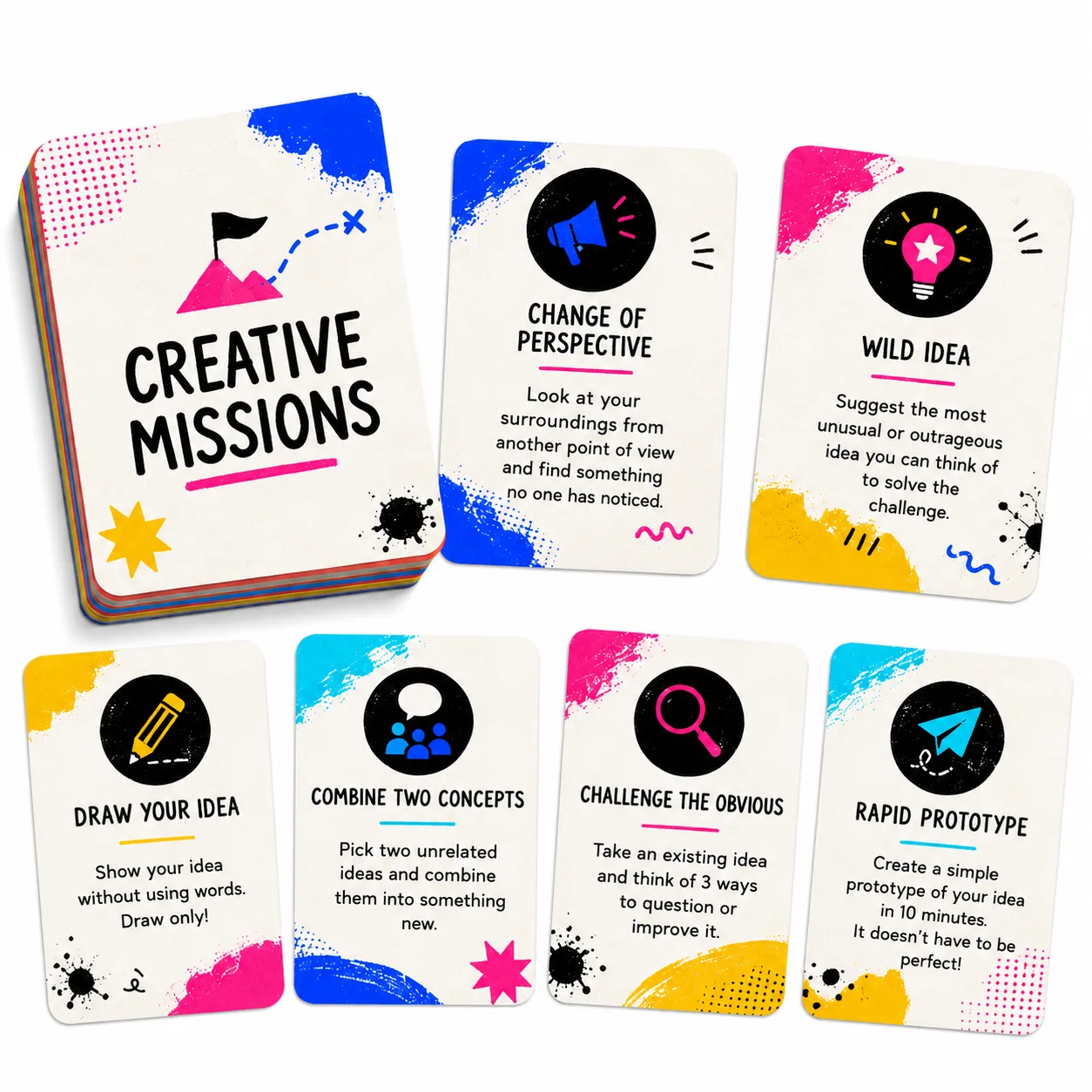
Creative Mission Cards for the Classroom
Creative Mission Cards transform content review and synthesis into an expressive, low-pressure activity. Each card presents a challenge with a specific format — explain as a meme, draw in 30 seconds, act without words — that students must apply to the class topic. The brevity and playful component eliminate the anxiety of the “correct answer” and open space for real understanding to show itself in ways a conventional test would not allow.
Why the creative format activates understanding
To make a good analogy, a schematic drawing in 30 seconds, or an explanation in 10 words, the student must first understand what they are talking about. You cannot represent creatively what you don’t understand: creativity requires conceptual clarity as a starting point. Creative missions work as evidence of understanding because they make visible what the student knows in a form that is hard to fake with a memorized answer.
Variety of formats for different types of thinking
The deck includes missions that activate different types of processing: visual, verbal, kinesthetic, analogical. That variety is pedagogically important: not all students process content the same way. Visual missions favor those who think in images; verbal synthesis missions favor those who master language; mime missions favor those who learn by doing. By rotating formats across sessions, the teacher reaches more types of learners.
Missions as a unit closing
One of the most productive applications of the deck is as a unit closing: instead of a review quiz, each group draws a card and presents the learned content in the format they got. The result is a creative presentation where groups also learn from each other’s presentations, and the teacher gets informal evidence of understanding in a format the class remembers far better than a written test.
Frequently asked questions about Creative Mission Cards
What types of creative missions does the deck include?
The deck includes missions from different expressive categories: visual missions (draw the concept in 30 seconds, make a diagram with only 5 elements), verbal missions (explain the topic as if you were a news presenter, as if you were explaining it to a 5-year-old, or in exactly 10 words), performance missions (represent the concept with gestures without words, in mime), analogy missions (compare the topic with an everyday object, with an animal, with a weather phenomenon), and digital missions (explain as if it were a meme, as if it were a tweet of 280 characters). Each mission activates a different type of processing of the content.
How do you connect a creative mission with academic content?
The key is to apply the card's format to the content they are working on, not to the format in the abstract. If the mission is 'draw in 30 seconds' and the topic is cell mitosis, the drawing must represent some aspect of the mitosis process. If the mission is 'explain in 10 words' and the topic is democracy, the essence of democracy must be synthesized in exactly 10 words. The creative format is the vehicle; the academic content is the destination. This combination forces a level of synthesis and understanding that a conventional explanation does not require.
How long does each mission take?
Most missions are designed to be completed in 3 to 5 minutes. Visual missions (drawing) are usually faster: 30 seconds to 2 minutes. Analogy missions or more elaborate verbal ones may need up to 5 minutes. The brevity is intentional: time pressure forces prioritizing the essential and activates urgency creativity, which tends to produce more original results than open-ended reflection. To share results, about 5 additional minutes are enough for everyone to see what others did.
Do creative missions serve to assess understanding?
Yes, and they often reveal more about real understanding than a conventional test. When a student draws the water cycle in 30 seconds, the drawing shows which elements they consider essential and how they relate them. When they explain democracy in 10 words, the word selection reveals which aspects seem central to them. These evidence of understanding are harder to fake than a memorized answer: to make a good analogy or a good schematic drawing, you have to understand what you're talking about. The teacher can use the results as informal formative assessment input.
Do they work better individually or in groups?
It depends on the mission. Drawing or written synthesis missions work well individually because they allow each student to process content in their own way. Performance or mime missions work better in small groups because the performative component benefits from collaboration and play. The most dynamic variant is groups in competition: several groups receive the same mission and the results are compared at the end. This adds motivation without increasing individual pressure.
For which educational levels is it appropriate?
Creative Mission Cards work at all levels, but the type of mission varies. In primary, the most appropriate missions are visual (draw, make a simple diagram) and simple analogies (what animal does this concept resemble?). In secondary, the more sophisticated verbal missions (explain as a journalist, in 10 words, as a news presenter) and mime missions work very well. In higher education, complex analogy missions and journalistic or digital format ones are most productive. In all cases, the mission scales by adjusting the level of conceptual demand of the content to which it is applied.
How do you integrate creative missions into unit planning?
Creative missions work best as closing or synthesis activities rather than introduction activities. At the end of a unit, instead of a review quiz, the teacher can use the deck so each group presents the learned content in the format from their card. This turns the review into a creative presentation where groups also learn from each other's presentations. They also work well as transition activities between units: a mission on the topic being closed activates what was learned before entering new content.
What competencies does this activity develop?
Creative Mission Cards primarily develop Creative thinking (generating original representations of content), Metacognition (to make a good creative representation, you need to be clear about what you understand and what you don't), Assertive communication (expressing ideas in non-conventional formats), and Adaptability (working with the assigned format, not the preferred one). In group variants it also activates Collaboration.
What pedagogies support creative missions?
Creative Mission Cards apply principles of Challenge-Based Learning (each card is a concrete challenge with a defined format), Design Thinking (generating multiple representations of the same concept), and Game-Based Learning (the playful competition and time pressure turn review into an activity with its own energy). The creative synthesis component is also grounded in research on knowledge transfer: representing a concept in a new format consolidates understanding better than repeating it.