Why students study a lot and learn little
There is a frequent paradox in classrooms: students who say they studied several hours, who arrive at the exam with notes full of highlights and markers, and who the next day remember almost nothing of what they answered. It is not a problem of effort — it is a problem of strategy.
The most popular study techniques among students are, for the most part, the least effective for learning. Re-reading notes produces a sense of familiarity that is confused with comprehension. Highlighting creates the illusion of having processed information. Reviewing everything the night before produces short-term retention that dissolves in days.
Teachers assume, frequently, that students know how to study. They don’t. Effective study strategies are counterintuitive, require more effort in the short term and, precisely for that reason, students abandon them. Teaching them explicitly is one of the highest-impact interventions a teacher can make.
The research on study techniques
In 2013, John Dunlosky and his colleagues published in Psychological Science in the Public Interest a systematic review of the most commonly used study techniques, rating their effectiveness based on available evidence. The results surprised even researchers in the area:
Attempting to recall information without looking at notes: asking yourself questions, closing the notebook and writing everything you remember, answering flashcards.
Distributing study in sessions separated over time, instead of concentrating it in one intense session the night before.
Asking oneself "why is it this way?" and "how does this relate to what I already know?" while studying.
Reformulating content in one's own words, as if explaining it to someone else.
Produces a sense of familiarity that is confused with comprehension, but does not strengthen long-term memory.
Re-exposes to the information but does not force the brain to actively retrieve it. Short-term retention that dissolves quickly.
Produces recognition without comprehension. Students remember the terms but cannot use them in new contexts.
The gap between what students do and what works is enormous. And because nobody taught them the effective techniques, they keep using the ineffective ones.
The testing effect: why questioning yourself is better than re-reading
The most effective — and most underused — technique is retrieval practice. The central finding, replicated in dozens of studies since the original experiments of Roediger and Karpicke (2006), is simple: attempting to recall information produces greater long-term retention than re-exposing to that information.
This is called the testing effect. Not because the exam itself generates learning, but because the act of attempting to retrieve information from memory strengthens the memory trace more than any other activity.
The practical implication is direct: the time students spend re-reading their notes would be more productive if they used it asking themselves questions about the material. Close the notebook and write everything they remember. Answer questions without looking. Explain the topic to a classmate or to themselves out loud.
The exit ticket at the end of each class is, in essence, a retrieval practice exercise: the student must access what they learned without looking at notes. Used consistently, it not only serves to evaluate formatively — it is also a study technique incorporated into the class routine.
Distributed practice: why studying the night before doesn’t work
Hermann Ebbinghaus described in 1885 what he called the forgetting curve: the speed at which the brain forgets information that is not reinforced is predictable and fast. Without review, 50% of what was learned is lost in the first day and 80% in the first month.
What counteracts forgetting is distributing study over time. Studying a topic for 30 minutes today, and then returning to it for 20 minutes in three days and again in a week, produces much greater retention than studying for 80 minutes the day before the exam. The intensive session produces short-term retention; distributed sessions produce long-term retention.
For teachers, this has two implications. The first belongs to planning: returning regularly to previous content — even briefly — instead of considering each topic “closed” when the unit ends. The second is explicitly teaching students that distributing study works better, even if it feels less intense.
The visual timer allows structuring study sessions in blocks with breaks, which makes the rhythm visible and avoids the trap of studying many hours in a row without consolidating.
How to integrate these strategies into class
Before introducing new content, spend 5 minutes having students write everything they remember from the previous class without looking at notes. It is more effective than an oral review where only those who remember respond — here everyone must try.
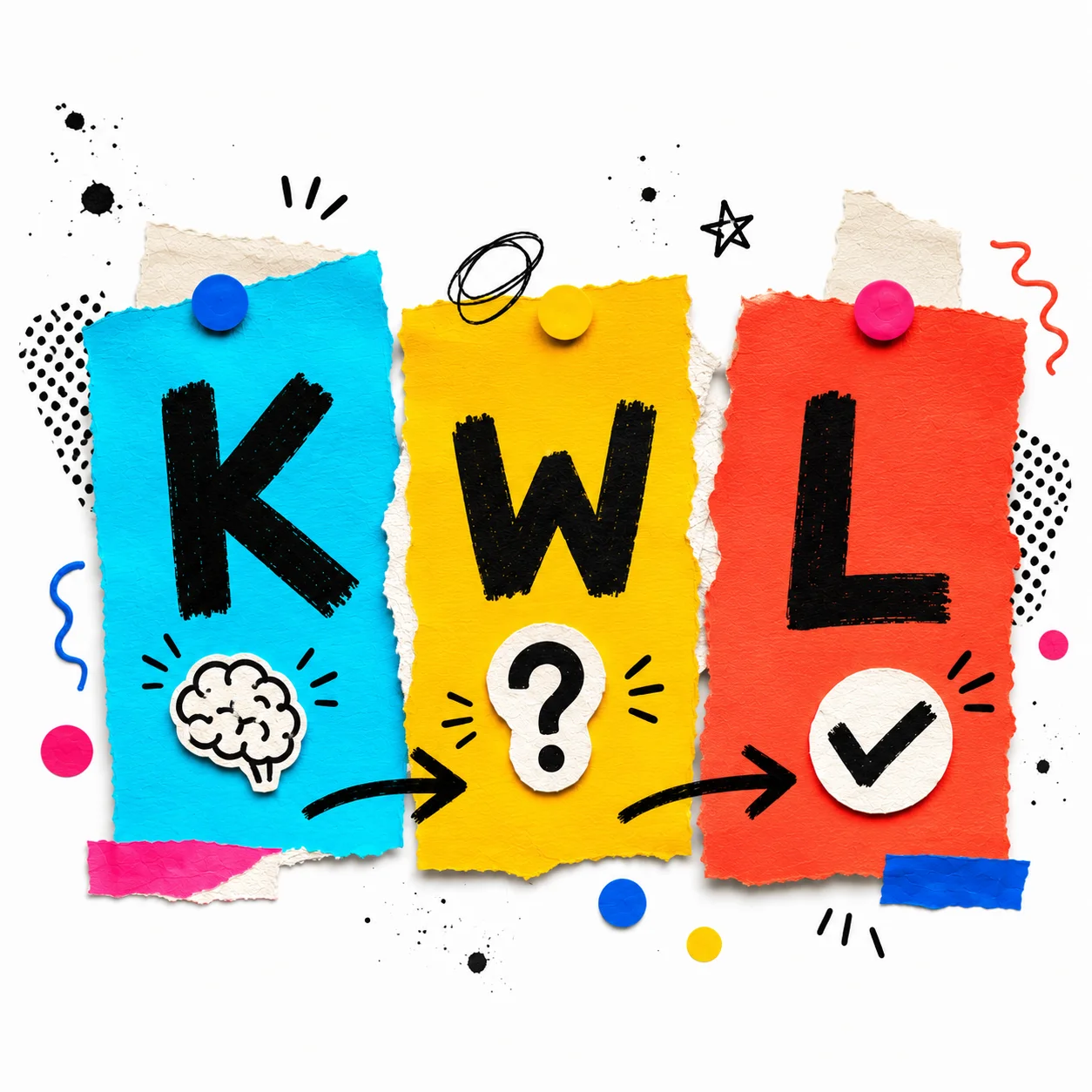
The "what I already know" column activates prior knowledge. The "what I want to learn" column turns the student's questions into a guide for study. The "what I learned" column is a synthesis exercise that consolidates understanding.
Instead of presenting content and asking if it was understood, interrupt regularly with questions like "why do you think this is the case?" or "in what other situation have you seen something similar?" This type of deep processing produces better retention than passive listening.
Students usually plan how much time they will study — but not what they will do in that time. Helping them design a study session with specific techniques (first retrieval, then review of what they did not remember, then practice exercises) produces better results than letting them decide how to use the time.
Free tools for teaching study skills
KWL chart — to activate prior knowledge and guide study
The three columns of the KWL chart structure the learning process in three moments: before, during and after. The “what I already know” column is an exercise in retrieving prior knowledge — not to evaluate the student, but to connect the new with what already exists in their memory. The “what I want to learn” column turns study into an activity guided by one’s own questions. The “what I learned” column is active synthesis: the student decides what was most important and formulates it in their own words.
I Used to Think, Now I Think — to make learning visible as change
This tool documents the difference between initial understanding and current understanding. For teaching study techniques, it has particular value: when students see that their understanding changed in concrete terms — that they used to think re-reading was enough and now know why it is not — they internalize the learning more durably than if they had only listened to an explanation.
Exit ticket — as incorporated retrieval practice
Using the exit ticket consistently at the end of each class has a double effect: it formatively evaluates the teacher on what the group understood, and exercises retrieval practice in students. The key is in the formulation: questions must require accessing what was learned without looking at notes, not describing what was done in class. “Explain in your own words why…”, “Give an example of…”, “What would happen if…?” are retrieval questions. “What did we do today?” is not.
Visual timer — to practice distributed study
The visual timer allows structuring the study session in time blocks with scheduled breaks. In the context of teaching study techniques, it can be used to model what a well-planned session looks like: 10 minutes of active retrieval (close the notebook and write everything remembered), 5 minutes of comparison with notes to identify what was missing, 10 minutes of practice with exercises. The timer makes the time distribution visible and prevents students from spending the whole session on the most comfortable activity — usually re-reading.
Kanban board — to plan study as a process
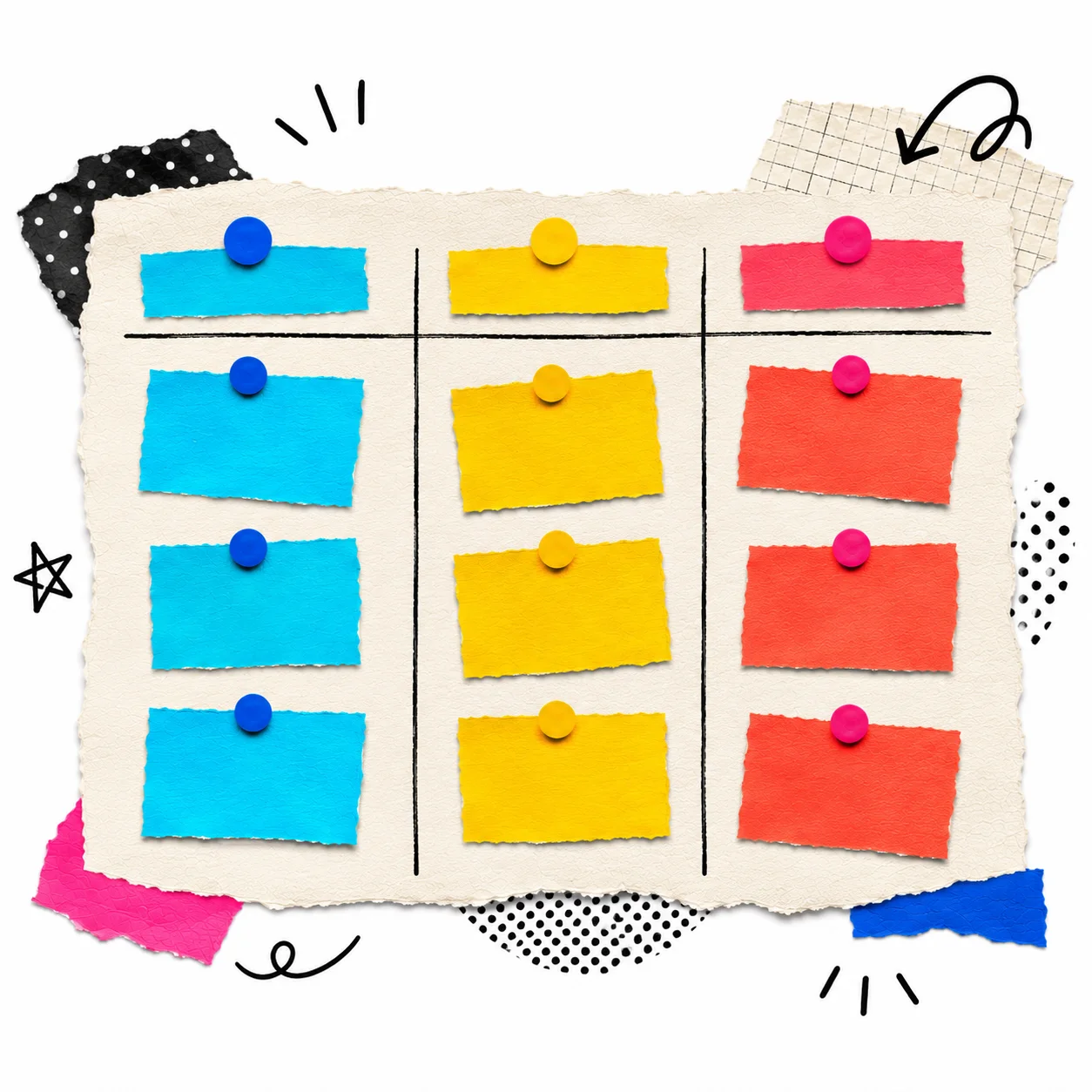
The kanban board organizes study tasks in columns: what needs reviewing, what is in process and what is consolidated. For studying, this means students distinguish between topics they master, topics they are working on and pending topics. This visible planning reduces the feeling that “everything needs to be studied” and allows prioritizing effort where it matters most.
Common mistakes
Teaching study techniques abstractly. Telling students that retrieval practice is more effective than re-reading does not produce change if they do not practice the technique in class. Study techniques are learned by using them, not by listening that they exist. The teacher who incorporates active retrieval into the class routine is teaching the technique without needing a separate class on “how to study.”
Assuming students will plan on their own. Planning study is a skill that requires explicit teaching and practice. Students who have no experience with it tend to use study time on the most comfortable activities (re-reading, reviewing what they already know) and avoid the most effective ones (active retrieval, practicing what they have not yet mastered). Modeling how to plan a study session is as useful as modeling how to solve a problem.
Treating study as exclusively the student’s responsibility outside the classroom. Most of students’ study time occurs outside class, without supervision. But study techniques are learned in class, where the teacher can model them, structure them and give feedback on how they are being used. Every time active retrieval practice is done at the start of class, a study technique is being taught that students can take home.
What competencies it develops
- When students observe how they learn — what techniques work for them, when they need more time, what types of errors they make — they are developing metacognition: the capacity to think about their own learning process and adjust it.
- When they plan how they will study, distribute time and monitor their progress, they are exercising self-regulation: the capacity to regulate one’s own behavior toward an objective.
- When they define what they want to learn and how they will achieve it, they are practicing goal planning applied to their own learning.
- When they distribute study over time and resist the temptation to leave it for the day before, they are training time management with a real and measurable consequence.
- When they understand how they learn and can apply that knowledge to any new content, they are building the capacity to learn to learn: the most transferable of all competencies.
How to start
At the start of the next class, ask students to close their notebooks and write on paper everything they remember from the previous class. Then compare with notes. This 5-minute exercise is active retrieval — the most effective technique — and also formative diagnosis for the teacher.
Use the KWL chart at the start of the unit and return to it at the close. Save the initial responses and return them at the end so students can concretely see what questions were answered and what understanding they built.
Model a study session in class using the kanban board and visual timer. Show how time is distributed between active retrieval, review of what was missing and practice exercises. Students who see planning modeled are much more likely to use it on their own.