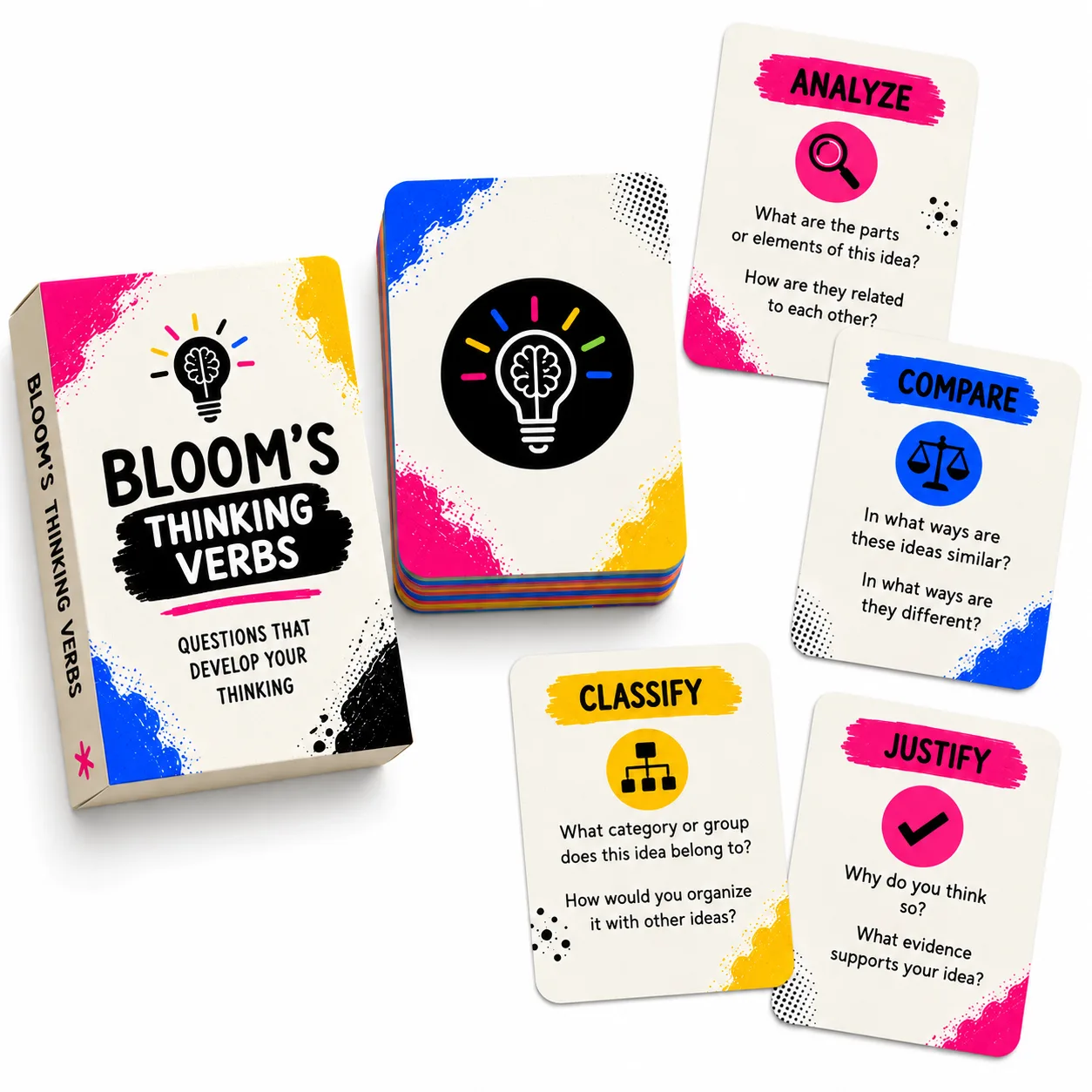
Bloom’s Taxonomy Cards for the Classroom
Bloom Cards turn Bloom’s Taxonomy into a dynamic classroom tool. Instead of consulting a static table, the teacher draws a card at random and immediately gets a cognitive level with its key verbs for formulating questions. It works in any subject and at any point in the lesson: as an opening to activate prior knowledge, as a closing to consolidate learning, or as a guide for deeper discussion of a text or problem.
Six cognitive levels in a deck
The deck includes one card for each of the six levels of the revised Bloom’s Taxonomy: Remember, Understand, Apply, Analyze, Evaluate, and Create. Each card shows the specific verbs that correspond to that type of thinking — the concrete tool the teacher uses as a starting point for formulating questions adapted to the current content. The difference between “What is photosynthesis?” (Remember) and “How would you design an experiment to prove that plants need light?” (Create) is exactly what separates repetition from deep understanding.
Higher-order thinking in any subject
Bloom’s Taxonomy is cross-curricular: the levels of Analyze, Evaluate, and Create apply equally to a literary text, a science experiment, a math problem, or a historical event. When different groups work on the same content with cards from different levels and then share their questions and answers, the discussion reveals how much more complex the understanding of a topic can be depending on the angle from which it is approached.
No preparation required
One of the main advantages of the deck is that it requires no specific preparation. Project it, draw a card, and adapt the verb to the class topic. This makes it especially useful for unplanned moments: when there are 10 spare minutes, when an explanation finishes early, or when the group needs a change of pace that keeps the focus on content.
Frequently asked questions about Bloom Cards
What is Bloom's Taxonomy and why use it in class?
Bloom's Taxonomy is a framework for classifying learning objectives across six cognitive levels: Remember, Understand, Apply, Analyze, Evaluate, and Create. It was proposed by Benjamin Bloom in 1956 and revised in 2001. Its pedagogical value is concrete: when a teacher only asks questions at the first two levels (remember and understand), students learn to repeat information but not to use it. Higher-level questions are what develop critical thinking and the transfer of knowledge to new situations. The deck turns that abstract framework into an immediate action: draw a card and formulate a question.
How many cards does the deck have and what appears on each one?
The deck has one card for each level of the revised Taxonomy: Remember, Understand, Apply, Analyze, Evaluate, and Create. Each card shows the level name, a brief description of what it involves cognitively, and a selection of representative verbs. For example: list, identify, name for Remember; explain, summarize, classify for Understand; use, demonstrate, solve for Apply; compare, examine, differentiate for Analyze; argue, justify, evaluate for Evaluate; and design, propose, construct for Create. Those verbs are the direct input for formulating questions about any content.
How do you use the cards to formulate questions on any topic?
The structure is: level + verb + content. If the card says Analyze and the topic is photosynthesis, the question could be: How does the light-dependent stage differ from the light-independent stage? If the card says Create and the topic is World War II, the question could be: How would you design an alternative peace plan for 1939? This combination works in any subject because the cognitive levels are cross-curricular. The teacher only needs to adapt the verb to the topic — the cognitive structure is given by the card.
Can it be used projected with the whole class?
Yes, that's the most common way. The teacher projects the deck on the classroom screen, draws a card at random, and formulates the question aloud or writes it on the board. The class responds together, in groups, or with a volunteer student. It also works in rotation mode: each group draws their card and formulates their own question about the same text or content everyone is working on. When they share, the class sees how the same topic can be approached from six different levels.
Is it also useful for lesson planning?
Yes. For planning, the deck works as a quick checklist: if tomorrow's lesson only has Remember and Understand activities, it's worth adding at least one Analyze or Evaluate activity. Some teachers use the deck before preparing the lesson: they draw three cards at random and plan activities covering those three levels. In class, the random card draw has the added value of unpredictability: students don't know which level they'll get, which maintains attention and prevents them from preparing only memorized answers.
For which educational levels is it appropriate?
The deck works from upper primary through higher education. In the early years, the teacher guides question formulation using the card's verbs as visible support. In secondary school and university, students themselves can draw the card and formulate the question for the group, turning the activity into a peer-assessment moment. The lower levels of the deck (Remember, Understand) are more accessible for groups with less mastery of the topic; the higher levels (Evaluate, Create) require greater conceptual depth and are most suitable for units already well advanced.
How many cards should be drawn per session?
For a 10-to-15-minute activity, two or three cards are enough. If the goal is a quick closing discussion, one well-used card is sufficient. If the goal is to cover several cognitive levels in a single session, draw three cards that span different ranges: one from the lower levels, one mid-range, and one from the higher levels. What matters is not the number of cards but the quality of the question formulated from each one.
What competencies does this activity develop?
Bloom Cards primarily develop Critical thinking (by forcing analysis, evaluation, and creation rather than mere repetition), Argumentation (higher levels require justifying and substantiating answers), and Metacognition (the student learns to identify which cognitive level they are operating at). In group work it also activates Collaboration and Assertive communication.
What pedagogies support the use of Bloom Cards?
The cards are grounded in Formative Assessment: level-based questions allow real-time diagnosis of what type of understanding students have. They also apply principles of Question-Based Learning, where formulating good questions is itself a pedagogical goal. At the curricular design level, the deck operationalizes the principle of constructive alignment: ensuring classroom activities work the same cognitive levels as the final assessment.