Logical Reasoning
Build valid arguments, detect fallacies, and follow chains of cause and effect.
Logic will get you from A to B. Imagination will take you everywhere.
— Albert EinsteinMastery progression
Confuses opinion with argument. Does not detect contradictions. Accepts conclusions without examining the premises.
Follows simple logical sequences. Detects obvious contradictions. Needs help building formal arguments.
Builds arguments with clear premises and conclusions. Detects common fallacies. Distinguishes correlation from causation.
Handles deductive and inductive reasoning fluently. Evaluates the formal validity of complex arguments. Constructs solid logical chains.
- Complete a simple logical sequence (if A then B)
- Detect when two statements contradict each other
- Order the steps of a process in sequence
- Build an argument with explicit premises and a conclusion
- Identify common fallacies such as the straw man or false dilemma
- Distinguish between correlation and causation using real data
- Evaluate whether a conclusion logically follows from the premises
- Analyze complex formal arguments with multiple chained premises
- Design logical proofs to verify hypotheses
- Detect subtle fallacies in sophisticated discourse
Questions that activate it
Tap a card to see the coaching guide
Is that because A causes B, or because A and B happen together?
Tap to flipThe confusion between correlation and causation is one of the most common logical errors. Use it with data, statistics, and news.
Tap to returnWhat premise do you need for that conclusion to be valid?
Tap to flipReverses the process: instead of going from premises to conclusion, ask them to find the missing premise. A powerful logical exercise.
Tap to returnIs there a third option besides those two?
Tap to flipDetects the false dilemma. Students often present only two options. There are almost always more. Ideal for debates and dilemmas.
Tap to returnIs that always true or only in this case?
Tap to flipTeaches how to distinguish between a general rule and a particular example. Avoids hasty generalizations. Very useful in science and history.
Tap to returnWhat would have to happen for this to be false?
Tap to flipIntroduces the concept of falsifiability. If nothing can prove something is false, it's probably not a solid argument.
Tap to returnCan you explain your reasoning step by step?
Tap to flipMakes the logical chain explicit. Many students reach the right conclusion but can't explain how. The process matters as much as the result.
Tap to returnAre you attacking the idea or the person who said it?
Tap to flipDetects the ad hominem, one of the most frequent fallacies in school life. Teaches students to separate the argument from the person arguing.
Tap to returnWhat evidence would you need to change your mind?
Tap to flipEvaluates whether the student holds a logical or dogmatic position. If no evidence would change their mind, they are not reasoning — they are believing.
Tap to returnA study showed that students who learn to identify logical fallacies are 45% more resistant to misinformation on social media.
Roozenbeek & van der Linden, 2019 — CognitionIdeas for developing it
- Solve logic puzzles that require step-by-step deduction
- Who-is-who games with yes-or-no questions
- Identify the fallacy in an argument before responding
- Build a counter-argument that attacks the premises, not the person
- Fallacy catalog: each week study one fallacy and find real-world examples
- Fallacy bingo: mark fallacies that appear in news or advertising
- Explain why a formula works, not just how to use it
- Find the error in a proof that contains an invalid step
- Analyze misleading graphs and explain what logical trick they use
- Given two correlated data points, investigate whether there is causation or coincidence
- Write pseudocode with conditionals: if X then Y; if not, Z
- Debug an algorithm by finding where the logic breaks down
- Design an experiment that can falsify a hypothesis
- Analyze whether a scientific conclusion follows from the data presented
- Analyze an advertisement: what logic does it use to persuade you?
- Evaluate a rumor: what evidence is there? who said it? does it make sense?
- Board games that require logical strategy (chess, Mastermind, Set)
- Sudoku and other logic puzzles with progressive difficulty
Resources and tools
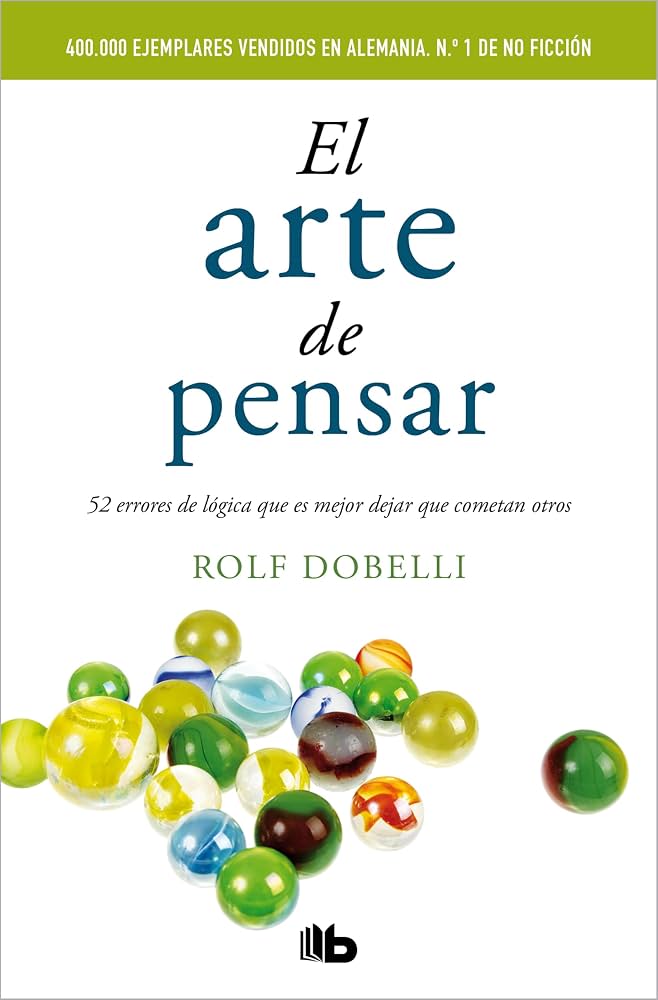 BookThe Art of Thinking Clearly — Rolf Dobelli
52 logic errors we all commit. Each chapter is brief and uses everyday examples. Ideal for secondary students.
Debate CardsWebsiteLogical Fallacies — Yourlogicalfallacyis.comInteractive poster with the most common logical fallacies, explained with clear examples. Downloadable as a poster.
Dilemma CardsVideoLogical Fallacies Explained — TED-EdTED-Ed series on logical fallacies with animations. Ideal to share in class.
Bloom CardsESWebsiteLogic for Everyone — Educación 3.0Logic activities and games for primary and secondary students.
Cause-Effect DiagramAgreement ScaleSilent DebateQuestion Dice