Frequently asked questions about Build What I Say
What is Build What I Say and how does the game work?
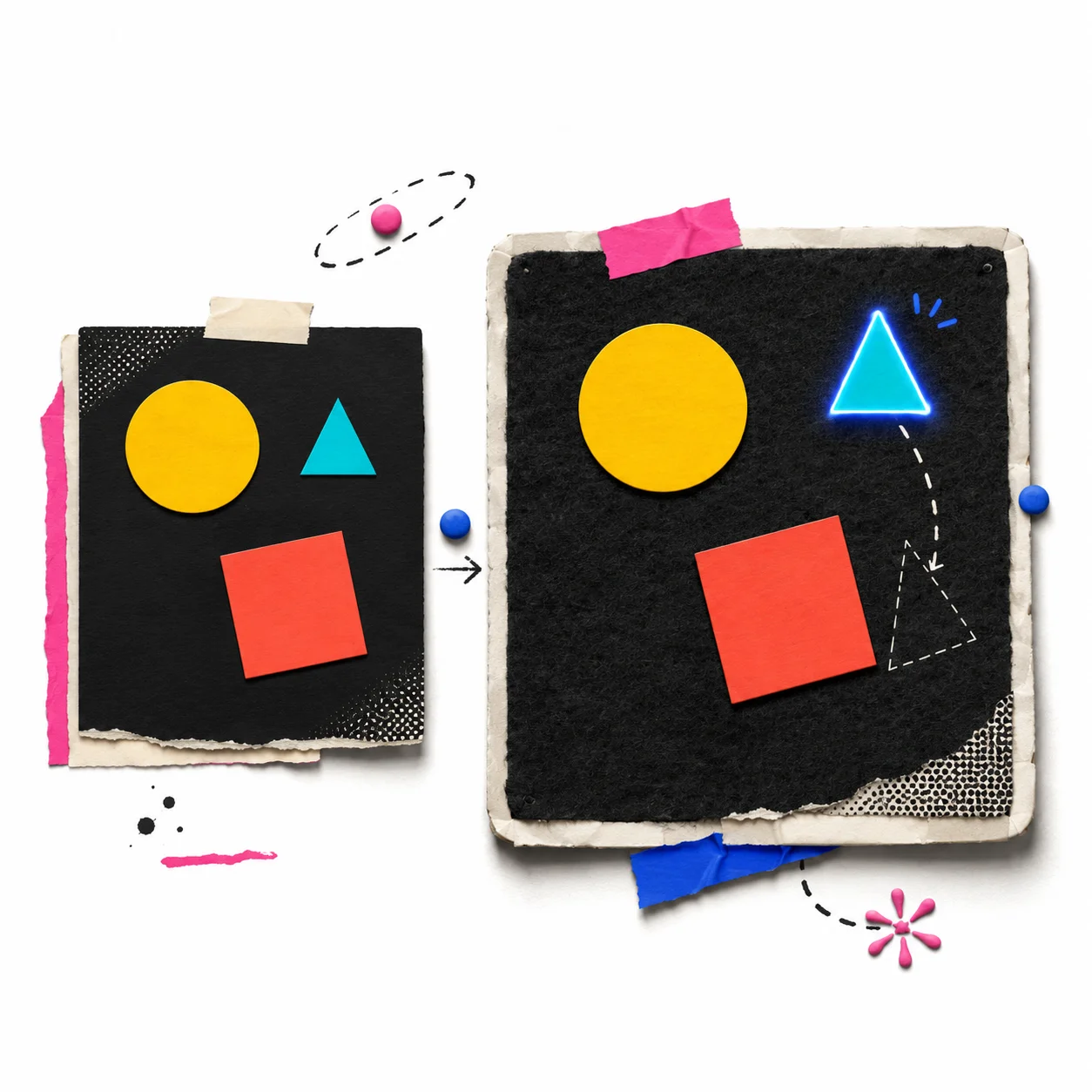
Build What I Say is an educational communication and geometry game played in teams. The core mechanic: one player (the describer) sees a reference card with colored geometric shapes arranged in a specific layout and must describe it verbally to their partner (the builder), who drags and positions digital shapes to recreate what they hear, without being able to see the original card. When time is up, both images are compared side by side and the team self-evaluates. The game is the digital version of the well-known Shape Builder: Communication Conundrums, adapted for use with a single device in the classroom. It also includes a Memory Challenge mode where one player memorizes the card in a few seconds and then reconstructs it from memory.
Why is it difficult to describe shapes with words and what does that teach?
Describing an image with precision using only words is a surprisingly complex skill. It requires transforming visual information into structured language: choosing the right terms (circle, square, triangle), spatially locating each element (top left, overlapping, below), indicating orientation (rotated 30 degrees, tilted to the right) and doing so in a logical order the other person can follow. In practice, students discover that words they thought were clear turn out to be ambiguous ('slightly tilted' can mean very different things to two people). That gap between what we think we communicated and what the other person understood is exactly what makes the game powerful: the final comparison makes the imprecision of language visible in a concrete, memorable way with no negative consequences. It is a natural starting point for talking about assertive communication, clear instructions and technical vocabulary.
What competencies does this game develop?
Oral expression and linguistic precision: the describer must choose exact words to convey position, size, color and orientation — saying 'there is a red square' is not enough, you need to say where it is and how it is oriented. Active listening: the builder interprets verbal instructions and translates them into actions; if they do not listen carefully or do not ask for clarification in time, the result drifts from the card. Spatial and geometric vocabulary: relative position (above, below, to the left, overlapping), orientation (horizontal, vertical, tilted, rotated) and shape names — vocabulary that crosses math, geometry and science. Collaboration: in description mode the result depends on coordination between two distinct roles, neither can achieve it alone. Metacognition and communication reflection: the final comparison creates a natural instance of analysis — which instruction was confusing? what word would have worked better? This reflection is the most pedagogically valuable part. In Memory Challenge mode, visual memory and spatial retention are added: the player must retain the complete layout of the card in a few seconds and reconstruct it without references.
In what subjects and situations can it be used?
In Math and Geometry it is the most direct application: it works on the vocabulary of flat figures, relative position, orientation and rotation concepts, and can be used to assess whether students manage the geometric language, not just visual recognition. In Language and Communication it is ideal for working on the structure of clear instructions, the use of position connectors (to the left of, below, diagonally toward) and the difference between vague and precise description — it works as a starting point for writing instructional texts. In English as a second language it is one of its best applications: it requires describing spatial relationships functionally (next to, above, below, overlapping, to the right of) instead of repeating vocabulary without context. In Design, Art and Technology it works to introduce composition and visual communication concepts. In Science, precise description of structures and spatial relationships appears in biology (cells, organs), chemistry (molecules) and geography (maps). And in any subject it works as an icebreaker at the start of the year, as a transition activity between dense theoretical blocks, or as a dynamic with a new group.
What educational level is it suitable for?
The game scales well from 2nd or 3rd grade of elementary school through university, though the pedagogical depth varies by level. Lower elementary (6-8 years): recommended to use only easy cards (2 shapes, no rotation), focusing on shape names and basic position (above, below, beside). Upper elementary (9-12 years): medium difficulty cards, with more precise relative position vocabulary. Secondary and high school: hard cards with rotations, where the challenge is technical language and precision. Deeper reflections on communication, language ambiguity and descriptive strategies can be explored. Higher education and teacher training: it is a powerful metacognition tool: students analyze their own description patterns, identify linguistic biases and discuss instruction design. In teacher training specifically it works for exploring the importance of specific vocabulary in teaching.
What is Memory Challenge mode and when is it best to use it?
Memory Challenge mode changes the mechanic: instead of two players (one describing and one building), a single player sees the card for a limited time and then must reconstruct it from memory. The memorization time depends on card difficulty: 10 seconds for easy cards, 7 for medium and 5 for hard. Once the time is up, the card disappears and the player builds without reference. Unlike description mode, the 'View card' button is not available during construction. This mode is especially useful when you want to work on visual memory and spatial retention, when the group has an odd number or there are students working alone, as a more challenging variant for groups that have already mastered description mode, or when the teacher wants to assess individual geometric understanding without the communication variable.
How do you run the pedagogical debrief after playing?
The greatest value of the game is not the game itself but the conversation it generates afterward. Some questions to guide the debrief: What words did you use to describe the position of the shapes? Did they work well? (identifies spontaneously used vocabulary). Was there an instruction you did not understand well? How would you have phrased it differently? (works on revision and self-correction). What was harder to describe: the shape, the color or the position? (reveals which dimensions of spatial language are weakest). What strategy did the describer use to organize their description? (introduces the idea of structure: top to bottom, left to right, shape by shape). In communication or language courses, this debrief can lead to a written activity where students draft precise instructions for one of the cards, transferring oral learning to written language.
How do you organize the classroom and how many students participate?
The game works with a single device shared by all teams. The ideal setup is 2 to 4 teams of 4 to 6 students. Within each team, in the active turn the describer and builder play; the rest can observe and identify clear or confusing instructions. Between turns, waiting teams can prepare their description strategy or try to build the same card independently to compare afterward. For large classrooms (over 30 students): 3 or 4 large teams work well where non-active students have an observation task (for example, noting the position words used by the describer). For small classrooms or pair work: you can play in individual mode with Memory Challenge, or with 2 two-student teams that take turns. The device can be projected so the whole class sees the construction in real time, which adds tension and makes the game more dynamic as a whole-class activity.
What description strategies emerge naturally in the game?
When observing how students describe, three spontaneous strategies tend to emerge that the teacher can name and teach explicitly. Shape-by-shape description: 'First there is a large yellow circle... Then there is a red square...' It is the most common but can become disorganized without a clear spatial reference. Anchor-reference description: 'The large yellow circle is in the center. To the right of the circle there is a red square. Below the square there is a green triangle...' It is more efficient because it uses already-placed elements as reference points. Zone description: 'In the left half there is a horizontal orange rectangle. In the upper right corner there is a small circle...' It divides the space into sectors before starting. After the game, the teacher can show these three strategies and ask students to identify which they used and which they think would have worked better.
How does the point system and self-evaluation work?
At the end of each turn, the team sees the original card and their construction side by side and chooses a rating from 1 to 5: 1 (very different), 2 (somewhat similar), 3 (quite similar), 4 (very similar), 5 (identical). Points are calculated as rating x base points / 5. With 100 base points: rating 1 gives 20 points, rating 5 gives 100 points. The teacher can adjust the base points between 50 and 200 depending on the weight they want to give it. Self-evaluation is intentional: there is no external judge deciding right or wrong. This invites the team to be honest with itself and opens a conversation about similarity criteria. For advanced courses, the teacher can add their own evaluation rubric (position, orientation, relative scale) before playing, so students know exactly what they will be evaluating.
What shapes and colors are available for building?
The builder has 8 fixed-size pieces, the same as in the original physical game: large yellow circle, small yellow circle, large red square, medium blue square, small orange square, horizontal orange rectangle, vertical blue rectangle, and green equilateral triangle. The shapes can be dragged to the building area (dark felt-like surface), positioned freely and rotated in 15-degree increments. Multiple copies of the same piece can be used. They cannot be resized, which maintains fidelity with the physical game mechanics and eliminates a dimension of complexity so the challenge lies in position and orientation.
How many reference cards does the game have?
The game includes 20 reference cards organized in three difficulty levels. Easy (7 cards): 2 shapes without rotation, ideal for elementary school or for introducing the game. Medium (6 cards): 3 to 4 shapes with light rotations (15-20 degrees), for groups with prior experience. Hard (7 cards): 4 to 5 shapes with varied rotations and more complex compositions, for secondary school and higher education. Cards are selected randomly without repeating until the pool for the chosen level is exhausted, at which point the cycle restarts. The 'All' setting mixes all three levels, making each turn unpredictable and more entertaining.
Does it need internet, registration or installation?
No. The game runs completely in the browser: it requires no internet connection once the page has loaded, no account creation, no advertising and no installation. It works on any device with a modern browser: computer, laptop, tablet or phone. It is optimized for tablet or laptop with touchscreen, which is the most practical format in the classroom as students can pass the device between turns. It is free and has no paid version.
What pedagogies support the use of this game in class?
The game is grounded in Game-Based Learning: the playful mechanic creates a context of genuine communication with concrete and visible consequences, far more motivating than artificial vocabulary exercises. From Cooperative Learning, in description mode the result depends on coordination between two players with different information and roles — neither can achieve it alone, which generates the positive interdependence described by Johnson and Johnson. Vygotsky's Zone of Proximal Development also explains its power: describing shapes with precision is a skill students generally do not possess spontaneously but develop when the game creates the communicative need that motivates it. The cycle play-compare-reflect-improve aligns with Kolb's experiential learning: the final comparison is the reflective observation moment that consolidates learning. Finally, from Purposeful Gamification, the timer and point system are not decorative but functional: they generate the pressure that makes clear communication urgent and necessary.
Can it be used with a single device or projector for the whole class?
Yes, and in many cases it is the ideal format. With a projector or shared screen, the describer sees the card on their phone or on a screen facing only them, while the construction is done on the projector in front of the whole class — the builder receives instructions from the describer and moves shapes publicly, which turns the exercise into a whole-class activity where the rest of the class also observes, detects description errors and learns. It also works in pair format with a single device passed between turns, or in whole-class mode where one team plays at the front and others take notes on the description strategies used.
Can it be used as a warm-up or quick closing activity?
Yes, this is one of its most practical uses. As a 10 to 15-minute warm-up it activates spatial and geometric vocabulary before a theoretical class, generates group energy and gives the teacher a quick read of how fluent students' language is. As a closing, a short round after a geometry, design or communication unit works as informal assessment: the quality of descriptions clearly shows whether students internalized the vocabulary or only recognize it visually. Hard Memory Challenge mode (5 seconds) is the most agile format for quick closings because it does not require the describer to keep the card hidden.
What is the difference between Description mode and Memory mode in pedagogical terms?
They are two different games with the same base mechanic. In Description mode the focus is interpersonal communication: the describer must find the words while the builder interprets in real time, which works on negotiation of meaning, active listening and the ability to rephrase when the message is not understood. In Memory mode the focus shifts to visual encoding and working memory: the player observes a composition, retains it mentally and then reconstructs it alone. It works on sustained attention, mental spatial representation and short-term visual memory. Both modes develop geometric vocabulary, but through different routes: the first through communicative pressure, the second through retention pressure.