Frequently asked questions about Math Riddles
What are math riddles and how do they work in this game?
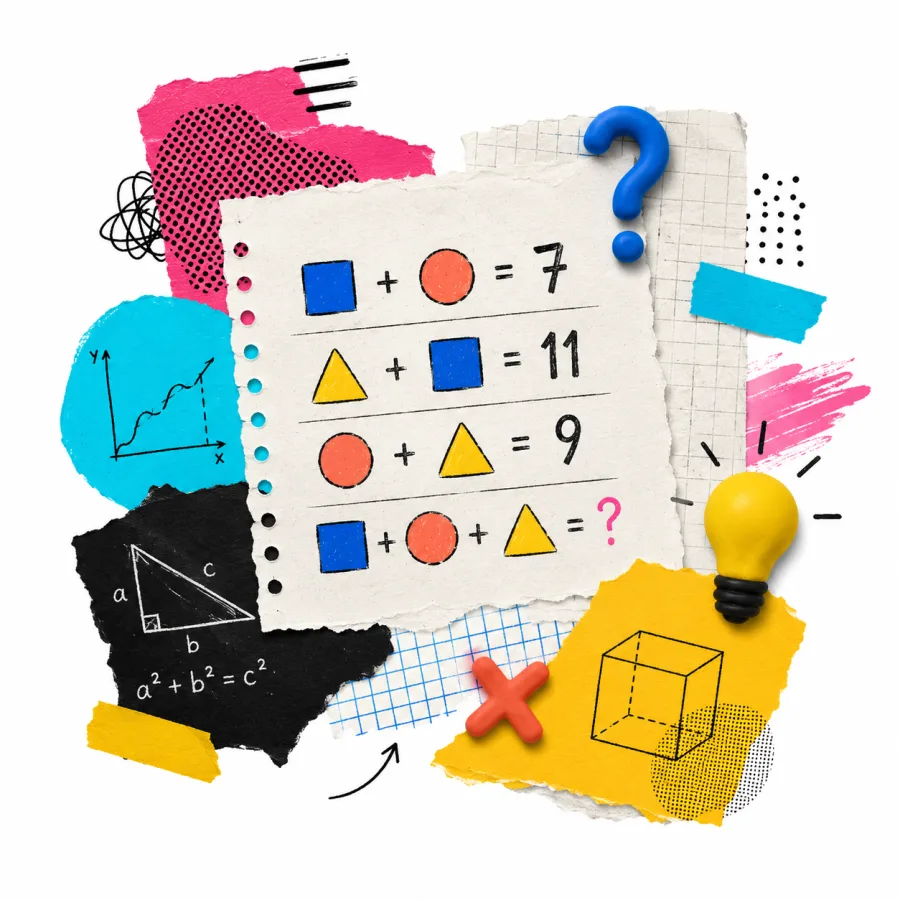
Math riddles (also called math puzzles, brain teasers or logic problems) are problems that challenge logical and numerical reasoning. In this game, each riddle appears on screen with its full problem statement. The player (or group) thinks about the solution and then clicks 'Reveal answer' to see the correct answer with a step-by-step explanation. There are over 35 math riddles with answers organized in 5 categories and 3 levels.
Do the math riddles include answers and explanations?
Yes. Each of the solved math riddles includes the correct answer and a detailed explanation showing how to reach the solution. For example, in Number riddles the algebraic steps are shown; in Geometry, the formulas applied; in Logic, the reasoning that dismantles the trick in the problem statement. No math riddle is left unsolved.
Are there easy math riddles for elementary school?
Yes. The Easy level includes math riddles for elementary school accessible from 4th grade: basic operations, number properties, simple patterns and classics like 'How many months have 28 days?' or 'A farmer has 17 sheep...'. These are easy math riddles that work as a warm-up or as a no-pressure start-of-class activity.
Are there hard math riddles with answers for middle and high school?
Yes. The Hard level includes math riddles for middle and high school students and adults: the 5-machines problem, the cistern with two pipes, the snail in the well, number paradoxes and combinatorial probability riddles. All hard math riddles with answers include the complete solution step by step, making them useful for studying or reviewing before a test.
What categories of math riddles and logic puzzles are included?
Numbers: operations, percentages, discounts, speed and algebraic problems. Logic: classic math riddles, language traps and reasoning (rabbits and chickens, the hotel paradox, the snail...). Sequences: number patterns, Fibonacci, prime numbers, perfect squares and cubes. Geometry: perimeters, areas, the Pythagorean Theorem and properties of figures. Probability: mean, mode, median, chances and the Birthday Paradox.
What is the difference between math riddles and brain teasers?
In practice they are the same: both math riddles and brain teasers or logic puzzles present a problem with a statement that requires reasoning to find the answer. The difference is in tone: brain teasers are often worded as a rhyme or language riddle, while math puzzles put more emphasis on logical-numerical reasoning. This game includes both types.
How do you use math riddles projected in class?
Project the screen, choose the category and level. Show the math riddle statement and give the group 1–2 minutes to think (you can combine it with the Visual Timer). Ask for answers aloud or in writing. Then reveal the solution with its explanation for the whole class. Logic riddles work especially well when projected: they generate debate, because the answer tends to be surprising.
Are these solved math riddles or just answers?
These are fully solved math riddles: each includes the answer and the complete solution. Number problems show the calculation steps. Logic ones explain the reasoning that leads to the answer. Geometry ones indicate the formulas used. The goal is that if a student did not reach the answer, seeing the explanation helps them understand why and learn from the process.
Is it free? Do I need to sign up?
Yes, it is completely free and requires no sign-up. Open the link and start in seconds from any device: computer, tablet or smartphone. There is nothing to download or install.