Feedback
Give specific and useful comments on others' work and receive feedback on one's own work without defensiveness in order to improve.
Feedback is the breakfast of champions.
— Ken BlanchardMastery progression
When giving feedback, it is vague ('it was good,' 'I liked it') or personal. When receiving it, they reject or ignore it. Does not distinguish constructive criticism from an attack.
Listens to feedback without reacting defensively. Can give basic comments. Struggles to be specific or suggest a concrete improvement.
Proactively asks for feedback. Gives specific comments focused on the work (not the person) and oriented toward action. Can incorporate perspectives that challenge their own.
Gives and requests feedback regularly, distinguishes types of feedback (descriptive, evaluative, process-based), and uses it systematically to improve their own work and the team's.
- Say what they liked about a classmate's work
- Listen to a comment about their work without interrupting
- Identify one concrete thing they would do differently in their own work
- Give feedback using a structure: 'I notice that... because... I suggest...'
- Separate what they feel about the comment from what they can learn from it
- Ask for a concrete example when they receive vague feedback
- Evaluate whether the feedback they received is fair, useful, or neither
- Give calibrated feedback to different audiences (peers, adults, teams with different contexts)
- Create feedback protocols for a group
- Analyze patterns in the feedback they receive to identify consistent areas for development
Questions that activate it
Tap a card to see the coaching guide
What part of this work did you do well, and what would you improve if you could start over?
Tap to flipActivates self-assessment before external feedback. Students who first give themselves feedback benefit much more from the feedback they receive afterward.
Tap to returnWhat do you need to know about your classmate's work to help them improve it?
Tap to flipShifts focus from judgment to understanding. Useful feedback comes from first understanding what the other person was trying to do.
Tap to returnWhen you received that comment, what did you feel first? And what did you think afterward?
Tap to flipSeparates emotional reaction from cognitive processing. The distinction between the two is key for learning to receive feedback without defensiveness.
Tap to returnDoes this feedback tell you what to do differently, or only what went wrong?
Tap to flipTrains the student to distinguish quality feedback from criticism without a proposal. Good feedback always points forward.
Tap to returnWould you give this same feedback to someone you just met?
Tap to flipDetects whether the feedback is personal or situational. If they wouldn't give it to a stranger, it's probably too personal to be useful.
Tap to returnWhat part of the feedback you received did you already know, even if you hadn't said it aloud?
Tap to flipConnects external feedback with internal self-assessment. When they align, learning consolidates faster.
Tap to returnThe largest meta-analysis on learning identified feedback as one of the factors with the greatest effect on academic performance (d = 0.73, equivalent to almost two additional years of progress), but only when it is specific, timely, and task-oriented — not person-oriented.
Hattie, J. (2008). Visible Learning: A synthesis of over 800 meta-analyses relating to achievement. Routledge.Ideas for developing it
- Practice 'Two stars and a wish': two concrete things that worked and one specific improvement suggestion
- Use the feedback guide: Is it specific? Does it focus on the work (not the person)? Does it propose something actionable?
- Work gallery where each student leaves a specific written comment for two classmates — use the Work Gallery
- Peer review before the final submission, with a structured feedback sheet
- Silent debate where at the end each student identifies the strongest argument from a classmate and explains why — use the Silent Debate
- Read a classmate's work and identify the strongest idea and the one that needs more evidence
- Complete 'I Used to Think / Now I Think' after receiving peer feedback
- Record the feedback received and note what you will do differently next time: builds the habit of closing the loop
Resources and tools
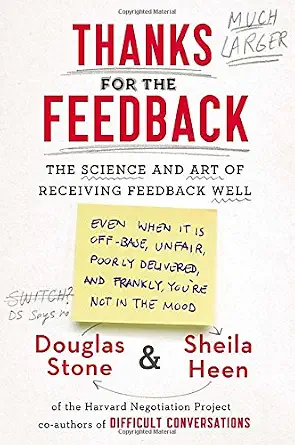 BookThanks for the Feedback — Douglas Stone & Sheila Heen
The most rigorous and practical book on the art of receiving feedback. Distinguishes three types of feedback (evaluative, coaching, identity) and explains why each activates different reactions.
Work GalleryBookVisible Learning — John HattieThe most cited meta-analysis in education. The chapter on feedback is the most solid reference for which types of feedback produce real learning and which do not.
I Used to Think / Now I ThinkESWebsiteEffective Feedback — clasesinteractivasComplementary pedagogy: what effective feedback is and how to design it for the classroom.
Silent DebateComprehension Stoplight