Dialogue
Build meaning with others through conversation, arriving together at understandings that no one had alone at the start.
In genuine dialogue there is no winner. If someone loses, everyone loses.
— David BohmMastery progression
Participates in conversations but waits their turn to speak rather than listening. Their responses don't connect with what the other said. Seeks to win or impose, not to understand.
Connects their contribution to what others said. Can rephrase someone else's idea before responding. Starts to distinguish between debating and dialoguing.
Asks questions that deepen the conversation, picks up others' ideas to build on them, and can change their position when the dialogue leads to something better.
Facilitates genuine dialogues in the group, tends to the conditions that allow everyone to think together, and recognizes when a conversation becomes collective meaning-making.
- Explicitly connect their comment to what the previous speaker said
- Rephrase someone else's idea before adding their own
- Ask a genuine question (one they don't already know the answer to) during a conversation
- Distinguish between debating (defending positions) and dialoguing (building understanding)
- Identify the moment when a conversation stopped being dialogue and became alternating monologues
- Sustain uncertainty without rushing to close an idea before it matures
- Point out when an idea emerged from the conversation and not from any single person
- Facilitate dialogue in large groups with very divergent positions
- Design questions that open genuine dialogue rather than debate or silence
- Evaluate the dialogic quality of a group conversation and propose adjustments
Questions that activate it
Tap a card to see the coaching guide
What did your classmate say that changed or enriched your idea?
Tap to flipThe most direct question for activating genuine dialogue. If a student can't answer it, they were not in dialogue — they were waiting for their turn.
Tap to returnAre you trying to convince or trying to understand?
Tap to flipThe central distinction between debate and dialogue. Helps students notice which of the two modes they are using right now.
Tap to returnIs there an idea in this conversation that emerged among all of you and that no one brought at the start?
Tap to flipThe question that makes collective intelligence visible when it appears. Celebrating that moment installs the value of genuine dialogue.
Tap to returnAt what point did it stop being a debate and become a dialogue?
Tap to flipInvites metacognition about the conversation itself. Very powerful after sessions where something shifted in the group.
Tap to returnWhat question would open this conversation rather than close it?
Tap to flipTrains the ability to formulate dialogic questions. Questions that open (with no single answer) sustain dialogue; questions that close (with a correct answer) end it.
Tap to returnCan you repeat the central idea from what the last two people who spoke said?
Tap to flipChecks for real listening. Dialogue only occurs when others' ideas actually land.
Tap to returnConnection map
The physicist and philosopher David Bohm proposed that individual thought is, at its origin, collective: all our ideas come from conversations we have internalized. In that sense, dialoguing well is remembering how human thought formed in the first place.
Bohm, D. (1996). On Dialogue. Routledge.Ideas for developing it
- Socratic seminar: one open question with no correct answer, where the group thinks together without the teacher providing answers — see Philosophy for Children
- 'Connect before adding' rule: whoever speaks must connect their contribution to something said by someone else before adding their own idea
- Fish Bowl: half the group dialogues in the center, the other half observes and gives feedback on dialogue quality (was there listening? did new ideas emerge?)
- Use the Live Word Cloud to visualize what concepts the group shares before opening the dialogue
- Silent Debate with a dialogic closing: 'What idea that wasn't mine did I incorporate into my own?' — the closing transforms debate into dialogue
- Give explicit credit: 'We built this idea together' — naming co-construction makes it visible and desirable
- Collaborative Idea Wall where ideas are built on previous ones (not just added): each post must reference or extend a previous one
- Dialogic writing: each student writes an idea, passes it to a classmate who extends it, who passes it to a third person who synthesizes it
Resources and tools
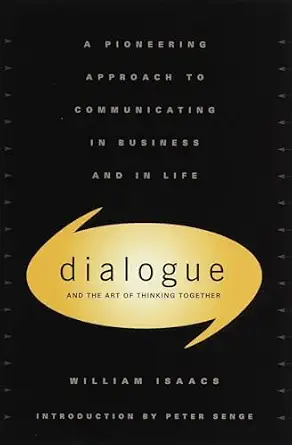 BookDialogue: The Art of Thinking Together — William Isaacs
A more applied version of Bohm's concept. Isaacs translates dialogue theory into concrete practices for groups. Very useful for designing dialogic classroom dynamics.
Silent DebateESToolSilent Debate — clasesinteractivasA way to transform debate into dialogue: students write and respond to ideas in silence, building on what others said.
Collaborative Idea WallESWebsitePhilosophy for Children — clasesinteractivasComplementary pedagogy: the philosophical community of inquiry as a structured form of genuine dialogue in the classroom.
Question DiceDebate Cards