Intellectual Humility
Recognize the limits of one's own knowledge, remain open to being wrong, and change positions when faced with better evidence.
The measure of intelligence is the ability to change.
— Albert EinsteinMastery progression
Defends their position even without solid arguments. Struggles to acknowledge mistakes in public. Confuses changing their mind with losing.
Can acknowledge errors when the evidence is very clear. Starts to distinguish between 'I'm right' and 'I have enough information to know if I'm right'.
Acknowledges what they don't know, asks questions without embarrassment, and revises their position when they find better evidence — naturally and without drama.
Models intellectual humility in the group: shares their revision process aloud, celebrates being convinced, and creates a climate where making mistakes is part of learning.
- Say 'I'm not sure' when they genuinely aren't
- Acknowledge a specific error without generalizing it
- Distinguish between an opinion and a verifiable fact
- Identify what new information would change their current position
- Explain how their argument improved or changed after listening to someone else
- Distinguish between a critique of their idea and a critique of them as a person
- Look for evidence against their own position before defending it
- Sustain uncertainty in complex topics without closing them prematurely
- Evaluate the weight of different sources of knowledge with their own criteria
- Model the revision of ideas in front of others so the group follows their example
Questions that activate it
Tap a card to see the coaching guide
What would you need to see or hear to change your position on this?
Tap to flipThe most powerful question for opening up thinking. If a student can't answer it, they're probably not thinking — they're defending.
Tap to returnIs there anything your classmate said that you could incorporate into your own thinking?
Tap to flipMakes visible the possibility of learning from others without surrendering. Seeks integration, not capitulation.
Tap to returnAre you defending the idea or defending the fact of having it?
Tap to flipThe most difficult and most important distinction. Helps detect when the ego is at the center, not the argument.
Tap to returnHow much of what you know about this did you learn in the last month?
Tap to flipInstills the notion that knowledge updates. What we know today may be incomplete or revisable.
Tap to returnHow did you feel the last time someone convinced you of something? Did you lose or gain?
Tap to flipReframes changing one's position as a gain, not a defeat. Key for students who associate yielding with weakness.
Tap to returnCan you find a solid argument against your own position?
Tap to flipThe steelman of one's own argument. Whoever can do this understands the topic far better than someone who can only defend it.
Tap to returnConnection map
A study by Porter & Schumann (2018) showed that simply saying 'I'm curious to understand why you think that' generates more belief revision than any logical argument presented afterwards. Curious openness deactivates defensiveness before the argument even arrives.
Porter, T., & Schumann, K. (2018). Intellectual humility and openness to the opposing view. Self and Identity, 17(2), 139–162.Ideas for developing it
- Ask students to defend the position opposite to the one they hold (steelman): forces them to understand the other side in depth
- At the end of a debate, each student writes in what ways their opinion changed or was nuanced — try the Silent Debate
- Use 'I Used to Think / Now I Think' as a unit closing: makes the evolution of thinking visible
- Revision journal: once a week, write something you learned that contradicts or nuances what you believed
- The teacher says aloud 'I was wrong' or 'I don't know, I'll look it up' to model the competency without drama
- Share a historical case in class where scientific knowledge changed due to new evidence (flat Earth, ulcers, continental drift)
- Include in the assessment: 'What were your assumptions at the start of this unit? Which ones did you revise and why?'
- A rubric that values the quality of position changes, not just the final position
Resources and tools
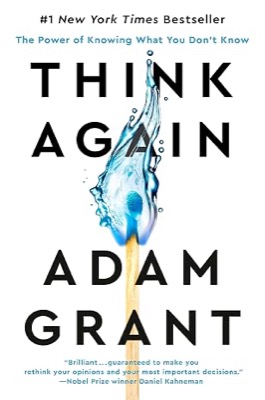 BookThink Again — Adam Grant
The most accessible and rigorous book on rethinking what we believe we know. Grant combines psychological research with concrete cases on how people who change their minds more often tend to make better decisions.
I Used to Think / Now I ThinkESWebsiteThinking Routines — clasesinteractivasComplementary pedagogy: visible thinking routines as a tool for externalizing and revising one's own thinking.
Opinion ThermometerAgreement ScaleSilent Debate