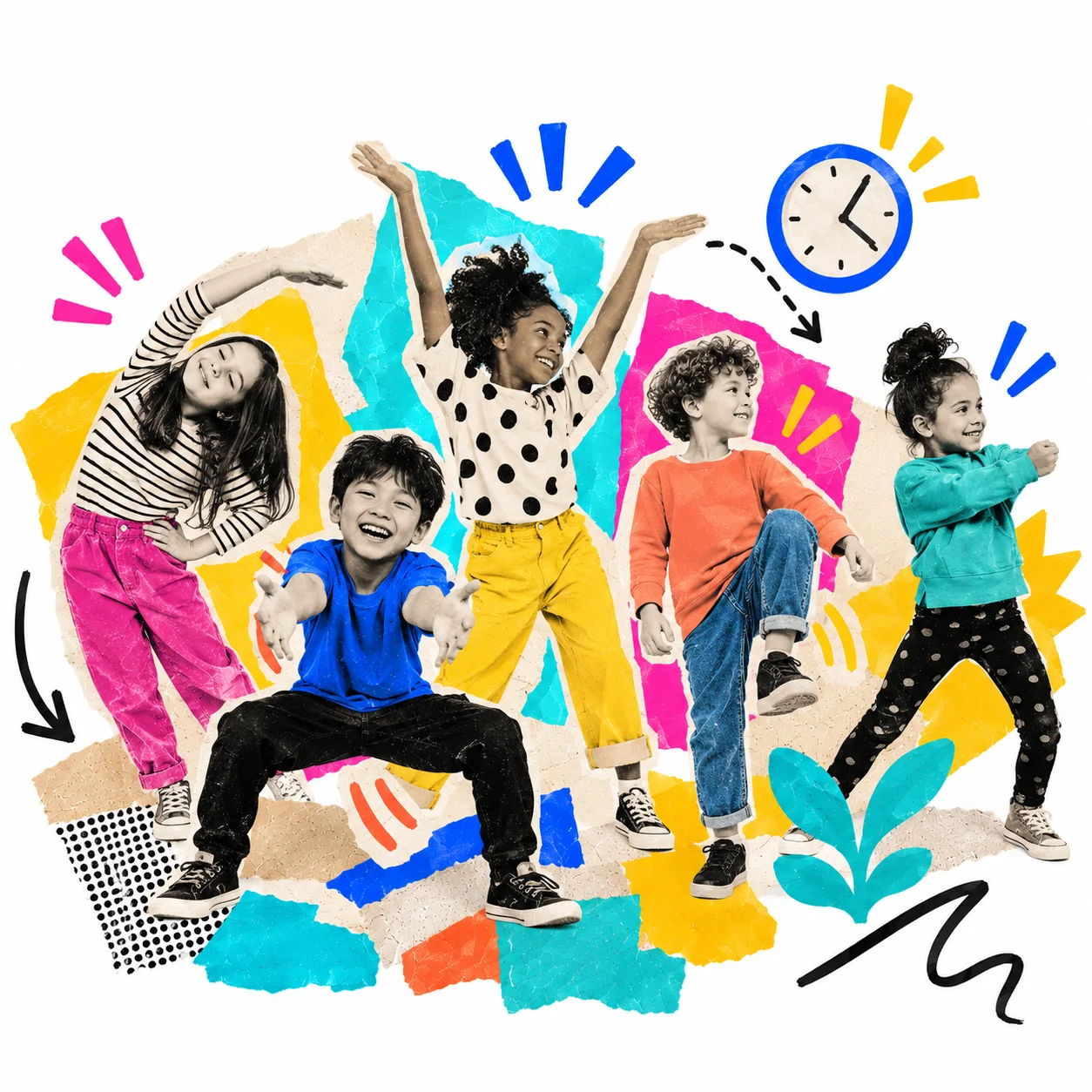
Active breaks for the classroom with timer
Active breaks are one of the most evidence-based interventions for improving attention and wellbeing in the classroom. This generator offers 56 movement, breathing, mindfulness, energy and social dynamics activities, with clear instructions projectable on screen and an integrated visual timer. No preparation or materials needed: choose the category and level, press Random break and in 10 seconds the group is already moving.
Movement activities for the classroom
Movement activities range from jumping jacks and marching in place to neck, shoulder and back stretches designed to relieve postural tension generated by hours in front of a screen or notebook. Each activity has detailed steps and a suggested duration of 2 to 3 minutes. They are designed to be done next to the seat and require no sports clothing, large space or materials of any kind.
Breathing techniques for the classroom
The breathing section includes validated techniques for different contexts: box breathing 4-4-4-4 to reduce the alert state, balloon breath adapted for early childhood with concrete visualization, humming breath with a relaxing buzz, 4-7-8 breathing to reduce anxiety before exams in secondary school, and coherent breathing 5-5 for adults with cardiac biofeedback evidence.
Mindfulness in the classroom
Mindfulness activities work attention, presence and emotional wellbeing without requiring any equipment. The 5-4-3-2-1 grounding interrupts anxiety in seconds; the body scan releases tension from feet to head; quick gratitude activates positive mental states that improve readiness to learn; and the mindful pause introduces the metacognitive practice of observing one’s own state before continuing to work.
Energy breaks to activate the group
Energy breaks are designed for moments when the group is low on energy and needs quick activation: after lunch, in the second half of a long class or before a demanding activity. The power pose, the explosive shake and the silent scream are body activation tools that work in limited spaces in less than 2 minutes.
Social dynamics for class cohesion
Social breaks go beyond activating the body: they strengthen the bond between classmates and generate class cohesion. The mirror with a partner, the wave of applause, the class pulse and collaborative counting are trust and mutual-attention exercises that improve the group climate and facilitate cooperative work in the activities that follow.
Printable active break cards
From the Select breaks button you can filter the 56 activities by category and level, mark the ones you want to include and generate a print with only the selected cards. Ideal for laminating and leaving available in the classroom, so students choose their own break when they finish a task, or so the teacher delegates leading the break to a different student each week.
Frequently asked questions about Active Break Generator
What are active breaks and why use them in the classroom?
Active breaks are brief interruptions (2 to 5 minutes) built into class to move the body, regulate breathing, train attention or build group cohesion. They are not lost time: educational neuroscience shows that a student's sustained attention has a ceiling of 20 to 25 minutes, after which performance drops measurably. A well-executed active break recharges attentional capacity, reduces cortisol and improves mood for the next activity. The effect does not last only the 3 minutes of the break: the following 15 to 20 minutes of work benefit from the recovery. Also, when breaks involve the group — wave of applause, mirror with a partner, collaborative counting — they strengthen class cohesion, which is a prerequisite for effective learning.
When is the best time for an active break in class?
The four best moments are: at the start of class, to activate the body and signal the beginning of the session (a short Energy or Movement break works well here); at 20–25 minutes of sustained work, when attention starts to wane (Breathing or Mindfulness restores focus without overstimulating); before a demanding activity like an assessment, presentation or debate (4-7-8 breathing and positive visualization reduce anxiety with clear evidence); and at the end of class as a ritual closing, where Social breaks work especially well. In double-period classes, two breaks are almost mandatory: one around minute 25 and another around minute 55 keep performance high throughout the session.
Do active breaks take time away from class?
No. A 3-minute break that improves concentration for the next 20 minutes has a return rate of nearly 7 to 1. The lost time is more than recovered in the quality of the work that follows. The real trap is continuing to teach when the group is no longer processing: that is genuinely lost time. Neuroeducation studies show that students who take regulated breaks perform better on assessments, make fewer errors in concentration tasks and show fewer disruptive behaviors in the second half of class. The question is not whether you can afford to do it, but whether you can afford not to.
What categories of active breaks does the tool include?
The tool includes five categories with 56 activities in total. Movement: jumping jacks, marching in place, shoulder circles, back stretch, neck rotations, hand shake, side stretch, chair push-ups, wrist mobility and more. Designed to do next to the seat without equipment. Breathing: box breathing 4-4-4-4, balloon breath (elementary and early childhood), double exhale, humming breath, relief sigh, 4-7-8 (secondary and adults), mountain breathing with visualization, exaggerated yawns, and coherent breathing 5-5 for adults. Mindfulness: 5-4-3-2-1 grounding, active listening, squeeze and release, color exploration, quick gratitude, body scan, positive visualization, gentle swaying, intention word, finger rain, mindful pause, cycle closing, and more. Energy: power pose, explosive shake, free dance, silent scream, crescendo applause, energy stretch and energizing breathing. Designed for moments when the group is low on energy or needs quick activation. Social: mirror with a partner, wave of applause, class pulse, collaborative counting, thanks to three, class signal, and the teacher's mirror for early childhood. Group activities that work connection, listening and class cohesion.
What educational levels is the tool designed for?
The tool covers five levels. Early Childhood (kindergarten, 3–6 years): very short activities, no reading, with imaginative and concrete instructions like animals in movement (imitating different animals in sequence), the growing seed (imaginative stretch from feet to head), breathing bubbles (exhaling very slowly so the bubble doesn't burst), finger rain (gentle tactile stimulation), loving hug (self-massage for emotional regulation) and the teacher's mirror (group imitation). Elementary (6–12 years): all activities marked for all levels plus specific activities with playful instructions, concrete visualizations and simple group dynamics. Secondary (12–18 years): includes more sophisticated techniques like 4-7-8 breathing, intention word and collaborative counting, framed around productivity and wellbeing. Adults (teacher training, workshops, teamwork): postural scan, coherent breathing 5-5, wrist mobility, neck decompression, mindful pause and cycle closing, oriented toward professional wellbeing and extended work. The All filter shows activities that work in any context and age.
What are Energy breaks and when should you use them?
Energy breaks are quick activation activities for moments when the group is low on energy, distracted or needs a reset before continuing. Unlike Movement breaks (slower and postural) or Breathing breaks (aimed at calming), Energy breaks seek to quickly raise the group's activation level. The best moments to use them: starting class after lunch, when the group is drowsy; in the second half of a long class; before an activity requiring high concentration; or when the class is particularly quiet or apathetic. The seven available Energy breaks are: power pose (30 seconds that change body chemistry), explosive shake (releases accumulated tension at once), free dance (immediately activates dopamine), energizing breathing (rapid nasal cycles that increase alertness), silent scream (catharsis without noise, very effective in secondary), crescendo applause (rhythmic group activation) and energy stretch (circulation and focus through posture).
What are Social breaks and what do they do in class?
Social breaks involve direct interaction between students: imitation with a partner, group coordination, brief physical contact or expressing gratitude. Their function goes beyond activating the body: they strengthen bonds between classmates, reduce anonymity in large groups and generate class cohesion. This matters for learning because students learn better in environments where they feel safe and connected to their peers. They are especially useful at the start of the school year to build class culture, after prolonged individual work periods, when the group climate is tense or fragmented, and in classes where there is group disconnection. The available activities are: mirror with a partner (coordination and mutual attention without words), wave of applause (sequential group synchronization), class pulse (silent handshake that travels through the group), collaborative counting (count from 1 to 20 without order or signals, just listening), thanks to three (specific gratitude between classmates), class signal (identity ritual the group invents and repeats) and the teacher's mirror (group imitation version for early childhood).
Does it work for kindergarten or early childhood?
Yes. The Early Childhood level includes activities specifically designed for children aged 3 to 6, with four fundamental characteristics: instructions of maximum four very concrete steps, narrative or imaginative structure (we are seeds growing, we blow bubbles that must not burst), no on-screen text so the teacher guides verbally, and duration between 60 and 120 seconds because the attentional window at that age is very short. Activities marked for all levels are also appropriate for early childhood when the teacher adapts the spoken language. For kindergarten, the most effective are Movement with imagination (animals, seeds) and Breathing with simple visualization (bubbles). Mindfulness activities like finger rain and loving hug introduce, in a very accessible way, emotional regulation from the earliest years, which is the foundation on which any learning skill is later built.
Can it be used with adults or in teacher training?
Yes. The Adults level includes seven activities designed for professional contexts: teacher training sessions, team meetings, workshops, university classes or extended work in front of screens. Adult breaks have two main focuses: injury prevention from sedentary work (wrist mobility, neck decompression, postural scan) and professional stress management (coherent breathing 5-5, mindful pause, cycle closing). Coherent breathing 5-5 has the most solid evidence in cardiac biofeedback: 5 seconds inhaling and 5 exhaling synchronize the heart rhythm with the autonomic nervous system, measurably reducing the stress response in less than 3 minutes. Cycle closing is especially useful for teachers: consciously finishing a task, acknowledging progress and defining the next concrete step reduces the sense of accumulated mental load between activities.
What should you do when students resist or laugh during the break?
Initial resistance is normal, especially in secondary school, where teenagers are more aware of social embarrassment. Four strategies that work: first, briefly explain why before starting (the brain needs to recharge like a phone to process what they learned); second, do it yourself first, with conviction and without apologizing; third, start with low social-risk activities like box breathing or color exploration, which require no visible movement or exaggerated expressiveness; fourth, avoid more physical breaks like the explosive shake or silent scream until the group has normalized them. Initial laughter is not real resistance: it is discomfort with something new. Within two or three weeks of consistent practice, most groups expect them and ask for them. The most determining factor is that the teacher does it naturally and with conviction, not that students want it from the beginning.
How many times a week are active breaks recommended?
The general recommendation is one break per hour of class, equivalent to 4 or 5 breaks per day distributed across different subjects. If you are starting to implement them, the most sustainable approach is to choose one subject and establish the break as a fixed ritual at minute 25. Once that practice is established, add another subject. In early childhood, breaks can be more frequent and shorter: one every 15–20 minutes makes sense for the attentional window at that age. For adults, the Pomodoro scheme (25 minutes of work, 5 of active break) is a proven and very easy-to-adopt framework. The goal is not to cover a perfect number of breaks: it is for students to internalize the habit of recognizing when their attention has dropped and having a concrete tool to recover it.
Can the break be led by students?
Yes, and it is one of the most effective ways to make it sustainable. Print the cards from Select breaks, laminate them or leave them in a visible spot in the classroom. Designate a rotating break leader: each week a different student chooses and leads the daily break. This transfers responsibility, increases group commitment and develops in the leading student communication, leadership and presence-in-front-of-the-group skills. In early childhood the teacher always leads, but children can choose which animal to imitate or which color to look for. In elementary, from third grade onwards students can lead Movement and Social breaks with a card in hand. In secondary and adults, rotating leadership is fully viable from the first week. In classes where this is established, students themselves signal when they feel they need the break.
Can it be used in classrooms with little space or fixed desks?
Yes. All activities are designed to be done next to the seat or while seated. Postural Movement activities (shoulder circles, neck rotations, hand shake, side stretch, wrist mobility, neck decompression) are done entirely from the chair. Standing activities like jumping jacks and marching in place need only the space between the chair and the desk in front. Breathing, Mindfulness and Social activities (mirror with a partner, class pulse) require no displacement. The more active Energy breaks like the explosive shake and crescendo applause are also done standing next to the seat in very limited spaces. No activity in the bank requires moving around the classroom, changing places or using the hallway.
What competencies do active breaks develop?
Self-regulation: both in the physical dimension (recognizing and modifying the activation state) and the emotional one (reducing anxiety, managing impulsivity). Breathing and Mindfulness breaks directly work this competency. Metacognition: students learn to observe their own internal state and choose a tool to modify it. Noticing that I am distracted and deciding to use box breathing is a metacognitive act that breaks, when practiced regularly, install as a habit. Sustained attention and concentration: Mindfulness breaks (active listening, color exploration, 5-4-3-2-1 grounding) directly train the ability to direct and sustain focus. Movement and Energy breaks restore it by eliminating accumulated cognitive fatigue. Collaboration and group cohesion: Social breaks develop active listening in a group, coordination without verbal instruction and the ability to synchronize with others. Perseverance: collaborative counting (you have to start over if two people speak at once) and clapping rhythms (which get progressively harder) train frustration tolerance and the ability to try again.
What pedagogies support the use of active breaks?
Active breaks articulate with several pedagogical frameworks with empirical support. Social-Emotional Learning (SEL): establishes that emotional regulation is a precondition for cognitive learning. Active breaks are one of the most accessible tools for working the socioemotional dimension within class time without adding external programs. Neuroeducation: movement activates BDNF (brain-derived neurotrophic factor), a protein that promotes the creation of synaptic connections and improves long-term memory. Slow breathing activates the parasympathetic nervous system, reducing cortisol and improving the processing capacity of the prefrontal cortex. Mindfulness in the Classroom: systematic practice of mindful attention in the classroom improves the ability to sustain concentration, reduces academic anxiety and improves students' subjective wellbeing. The Mindfulness and Breathing categories implement validated mindfulness techniques adapted to the school context. Microlearning: the structure of short episodes (2–5 minutes) interspersed with intense work blocks optimizes the learning curve. The Pomodoro model and its pedagogical variants demonstrate that alternating work-break outperforms extended continuous work in performance. Cooperative Learning: Social breaks generate moments of positive interdependence and peer contact that are key ingredients of cooperative learning, facilitating readiness for teamwork in subsequent activities.